

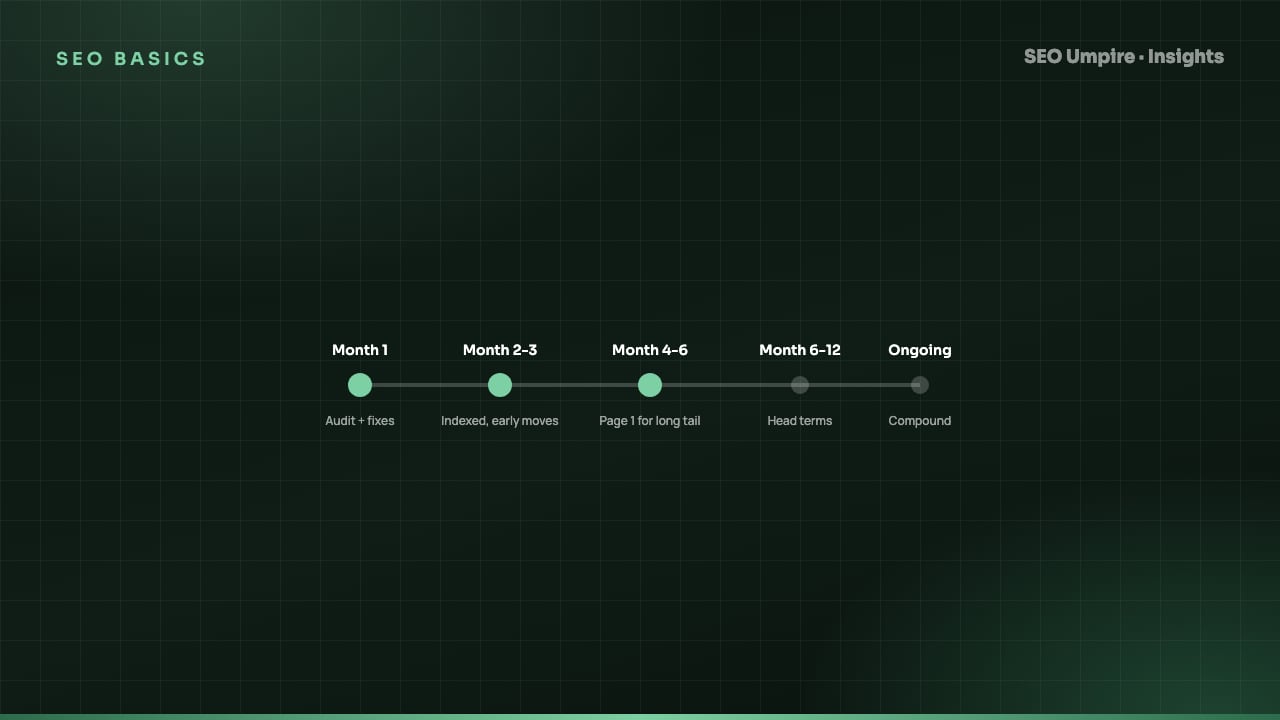
How Long Does SEO Take? Realistic Timelines by Site Type
How long does SEO take? Usually 3 to 6 months for measurable gains and 6 to 12 for competitive keywords. Timelines by site type and tactic, month by month.
SEO typically takes 3 to 6 months to show measurable results and 6 to 12 months to deliver traffic and revenue that justify the investment. The range is wide because the timeline depends on five things: how old and authoritative the site is, how competitive the target keywords are, whether technical problems are holding pages back, how fast you publish quality content, and how quickly you earn links. Technical fixes can move rankings in weeks; building authority in a competitive market takes quarters.
This post gives realistic timelines by site type and tactic, explains what to expect month by month, and shows which metrics tell you at month two whether the plan is working.
Why does SEO take months instead of days?
Four mechanics set the pace.
- Crawling and indexing. Google has to discover the change, crawl it and index it. For an established site that is hours to days; for a new or low-authority site it can be weeks.
- Evaluation. Ranking systems compare your page against everything else for the query. Signals such as links, engagement and consistency with other trusted sources accumulate over time rather than appearing at once.
- Core and system updates. Some re-evaluations happen in waves. A page improved in March may see its biggest move when a core update rolls out in May.
- Authority compounds slowly. Links, brand searches and mentions build over months. A site that has earned trust for years gets new pages ranked in days; a new site has to earn that trust first.
How long does SEO take by site type?
| Situation | First measurable movement | Meaningful traffic gain | Notes |
|---|---|---|---|
| New domain, competitive niche | 4 to 6 months | 12 months or more | Start with long-tail and build authority before chasing head terms |
| New domain, low competition | 1 to 3 months | 3 to 6 months | Clean technical setup plus 20 to 30 strong pages can rank quickly |
| Established site, technical problems | 2 to 8 weeks | 2 to 4 months | Fixing indexing, canonicals and speed often releases suppressed rankings fast |
| Established site, content refresh | 2 to 6 weeks | 2 to 3 months | Updating pages already on page two is the fastest content tactic |
| Established site, new topic area | 3 to 6 months | 6 to 9 months | Authority on one topic transfers partially to adjacent ones |
| Local business | 3 to 6 weeks for map pack | 3 to 6 months | Business Profile and reviews move faster than organic |
| Ecommerce, large catalog | 2 to 4 months | 6 to 12 months | Template fixes affect thousands of pages at once |
| Recovering from a penalty or core update hit | 3 to 12 months | Next core update or later | Depends on fixing the root cause, then waiting for re-evaluation |
How long does each SEO tactic take to work?
- Fixing crawl and index blockers (noindex by mistake, blocked CSS, broken canonicals): days to a few weeks. Often the biggest early win. Run the free SEO Umpire SEO checker to find them.
- Title and meta improvements: 1 to 4 weeks to see click-through rate changes once re-crawled.
- Page speed and Core Web Vitals: 4 to 12 weeks, because the Chrome User Experience Report uses a 28-day rolling window.
- Refreshing existing content: 2 to 8 weeks.
- Publishing new content: 3 to 6 months to settle into its ranking range, longer in competitive niches.
- Internal linking changes: 2 to 8 weeks.
- Earning links: 3 to 6 months before authority gains show in rankings for competitive terms.
- Schema and rich results: 1 to 4 weeks after validation and re-crawl.
What should happen each month?
Month 1: Foundation. Full technical site audit, fix indexing and speed blockers, set up Search Console, choose 30 to 50 target keywords in the keyword research tool and start tracking them in the rank tracker. Expect no traffic change yet.
Month 2: Quick wins. Rewrite titles and descriptions on key pages, refresh pages ranking in positions 8 to 20, fix internal links, add schema. Expect impressions to rise and some positions to move; clicks may lag.
Month 3: Content velocity. Publish new pages against the keyword plan, two to eight a month depending on resources. Expect new pages to index and appear at positions 20 to 60.
Months 4 to 6: Compounding. Early content settles, refreshed pages reach page one, impressions should be clearly up versus month one. This is when a plan either proves itself or needs changing.
Months 6 to 12: Authority. Links and brand signals start lifting competitive terms. Traffic and conversions become the headline metrics.
Which metrics tell you early that SEO is working?
Do not wait for traffic. Watch leading indicators in this order.
- Indexed pages matching your intended pages (Search Console Pages report). If this is wrong, nothing else matters.
- Impressions for target queries. Rising impressions at low positions mean Google is testing your pages.
- Average position of tracked keywords. Movement from 45 to 25 is real progress even with zero clicks.
- Number of keywords on page one and in the top three.
- Clicks and click-through rate.
- Conversions and revenue from organic.
If impressions and average position have not moved by the end of month three on an established site, something is wrong: wrong keywords, unresolved technical problems or content that does not match intent. The rank tracking guide explains how to separate noise from trend.
What makes SEO take longer than it should?
- Technical problems nobody found: a staging noindex copied to production, blocked resources, redirect chains, soft 404s
- Targeting head terms before the site has any authority
- Publishing content that restates the current top ten with nothing new; see does AI content rank
- Changing strategy every six weeks before anything has time to settle
- Site migrations or redesigns mid-campaign without a redirect map
- Thin, duplicated or cannibalizing pages competing with each other
- No internal links to new content, so it sits orphaned
How to make SEO work faster
- Fix everything that blocks crawling or indexing first; it is the only step with a result in days.
- Target keywords where you can realistically rank now: lower volume, specific intent, weaker competitors.
- Update pages already in positions 5 to 20 before writing new ones.
- Publish in clusters around a topic rather than scattered single posts, and link them to each other; the internal linking strategy explains hub-and-spoke structure.
- Add FAQ and structured data so pages qualify for rich results and answer-engine citations, which can arrive faster than classic rankings; see the AEO guide.
- Measure weekly, decide monthly, and give each change at least eight weeks before judging it.
Setting expectations with stakeholders
Agree on the timeline and the leading indicators before work starts. A simple framing that holds up: "Months one to three we fix and build and measure indexing, impressions and positions. Months four to six we expect page-one rankings for the first keyword group and visible traffic growth. Months six to twelve we expect competitive terms and revenue." Then report against those indicators every month so no one is surprised at month nine. The SEO reports for clients post shows a reporting format that makes the timeline visible.
Frequently asked questions
How long does SEO take to show results?
Usually 3 to 6 months for clear movement in impressions and rankings, and 6 to 12 months for traffic and revenue that justify the investment. Technical fixes on an established site can show within weeks; a brand-new domain competing on hard keywords can take a year or more.
Why does SEO take so long?
Google has to discover and index changes, re-evaluate the page against competitors, and observe how users respond. Authority signals such as links accumulate slowly, and ranking systems update in stages rather than instantly.
Can SEO results be faster?
Yes, by targeting lower-competition and long-tail keywords first, fixing technical blockers that stop indexing, updating pages that already rank on page two, and building internal links to new content. These produce movement in weeks rather than months.
How long does it take a new website to rank?
A new domain usually needs 6 to 12 months to rank for anything competitive. It can rank for low-competition, specific queries within 1 to 3 months if the content is strong and the site is technically clean and indexed.
Free audit, 32 checks, prioritized fixes and a PDF report in about 15 seconds. No signup.
Keep reading
 SEO Basics
Competitor SEO Analysis: A 7-Step Process to Find Keyword Gaps
Competitor SEO analysis in 7 steps: find your real search competitors, run a keyword gap analysis, compare content, technical health, links and AI citations.
 SEO Basics
Local SEO Guide: How to Rank in the Map Pack and Local Results
Local SEO explained: how Google ranks the map pack on relevance, distance and prominence, with steps for Business Profile, reviews, citations and schema.
 SEO Basics
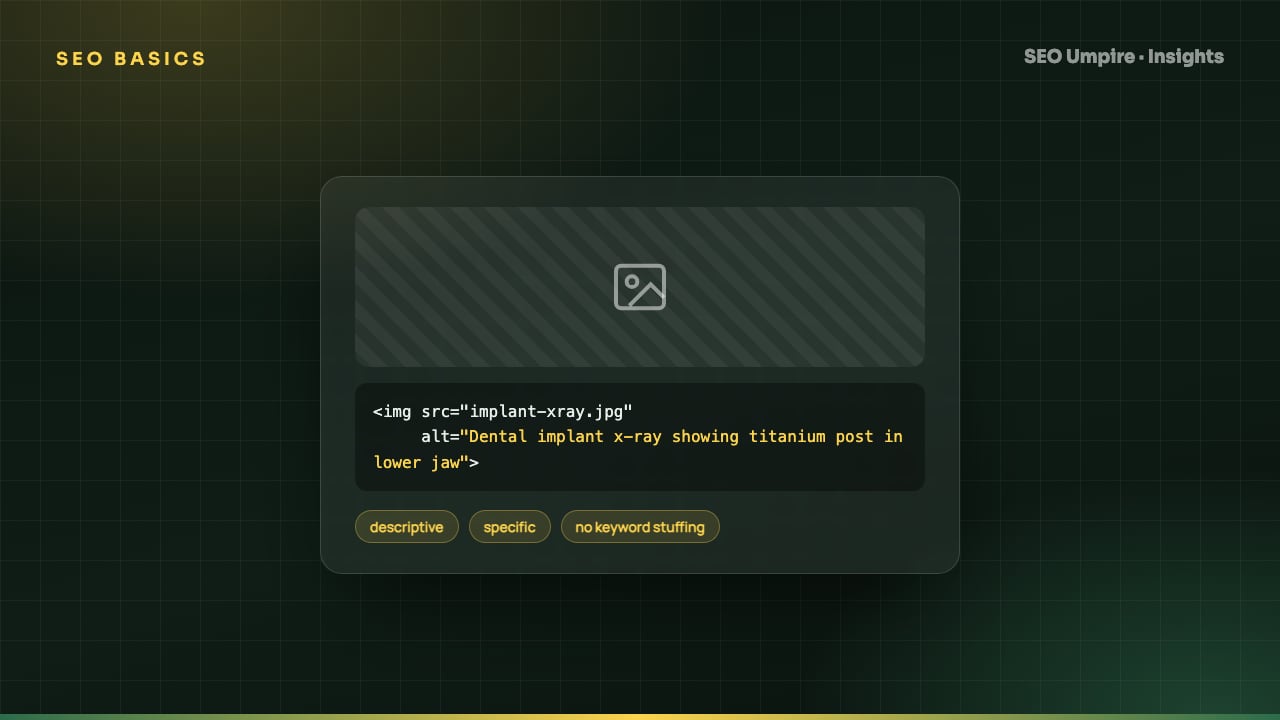
Image Alt Text SEO: How to Write Alt Text That Ranks
Image alt text is the HTML alt attribute describing an image for screen readers and search engines. How to write it, when to leave it empty, and full image SEO.
One short email a week: what changed in Google and AI answers, and the fixes that matter. No spam, unsubscribe any time.