

Local SEO Guide: How to Rank in the Map Pack and Local Results
Local SEO explained: how Google ranks the map pack on relevance, distance and prominence, with steps for Business Profile, reviews, citations and schema.
Local SEO is the work of making a business show up for searches with local intent, such as "emergency plumber near me" or "best tacos in Denver", in Google's map pack (the three listings with a map) and in the regular local organic results. Google ranks local results on three factors: relevance (how well your listing matches the query), distance (how close you are to the searcher or the place named) and prominence (how well known and well reviewed you are online). You win by optimizing a Google Business Profile, earning reviews, keeping citations consistent, building location pages and adding LocalBusiness schema.
This guide covers each lever in priority order with the specific checks that separate a listing that ranks from one that sits on page two.
How does Google rank local results?
Google documents three local ranking factors:
- Relevance: does your business category, name, services and content match what was searched?
- Distance: how far is your location, or the center of your service area, from the searcher or from the location in the query?
- Prominence: how well known is the business, measured through reviews, links, citations, mentions and the organic strength of your website.
You cannot move your building, but you can control relevance completely and prominence substantially. Most local SEO failures come from treating the Business Profile as a one-time form instead of a ranking asset.
Step 1: Claim and complete your Google Business Profile
The Business Profile is the single highest-impact task. Work through it in this order.
- Verify ownership (video verification is now common; have signage, equipment and a business card ready).
- Choose the primary category carefully. It is the strongest relevance signal. "Emergency Plumber" and "Plumber" rank for different queries. Check what the current top three use.
- Add every relevant secondary category, but only ones you genuinely serve.
- Business name: use the real name only. Stuffing keywords into the name ("Joe's Plumbing Best Denver Plumber") violates guidelines and gets reported by competitors.
- Hours, phone, website: exact and consistent with your site. Add holiday hours.
- Services and products: list each with a description; these feed relevance for long-tail queries.
- Description: 750 characters, lead with what you do and where, then differentiators.
- Photos: at least 20, with exterior, interior, team and work. Add new ones monthly.
- Q&A: seed the ten questions customers ask most and answer them yourself.
- Posts: weekly updates keep the profile active and give you room for offers and seasonal services.
Check the profile from an incognito window after each change; Google sometimes rejects edits silently.
Step 2: Build a review engine
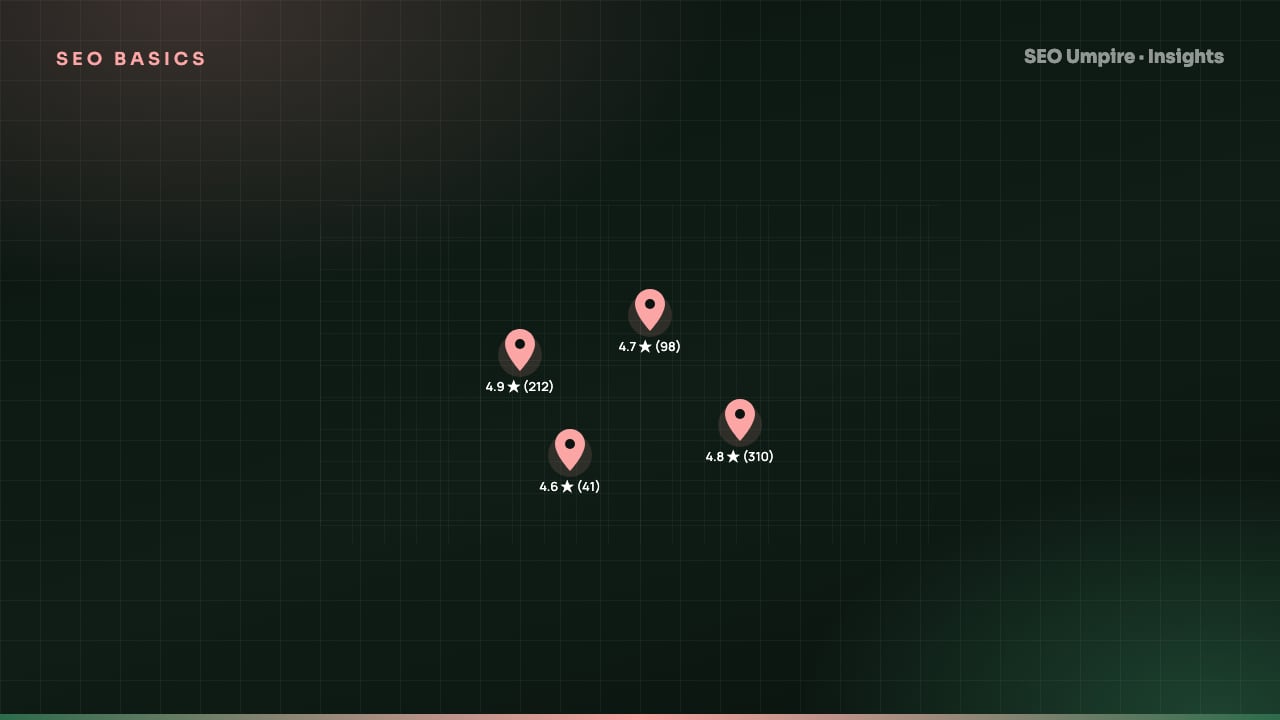
Reviews drive prominence and conversion. A listing with 4.7 stars from 240 reviews beats one with 5.0 from 9.
- Ask every customer within 24 hours of the job by text or email, with a direct review link.
- Aim for a steady weekly flow rather than bursts; a sudden spike after months of silence looks manipulated.
- Reviews that mention the service and city ("fixed our water heater in Lakewood") add relevance. You cannot write them, but you can prompt customers to describe what you did.
- Reply to every review within 48 hours. Replies are indexed and show responsiveness.
- Never gate reviews (asking only happy customers) or offer incentives; both violate Google's policies.
Step 3: Make citations consistent
A citation is any mention of your name, address and phone number (NAP). Inconsistent NAP across directories confuses the entity graph and dilutes prominence.
- Write a canonical NAP exactly as it appears on your Business Profile, including suite numbers and abbreviations.
- Fix the big aggregators and directories first: Apple Business Connect, Bing Places, Yelp, Facebook, the Better Business Bureau and the two or three directories that dominate your industry.
- Search for old addresses and phone numbers in quotes to find stale listings and update or close them.
- Add industry and local directories (chamber of commerce, trade associations, local news business listings).
Quality matters more than quantity. Fifty accurate, relevant citations beat 500 spam directories.
Step 4: Build location and service pages
Your website is the prominence engine behind the profile. Create:
- One page per physical location with the address, embedded map, hours, staff, photos, local reviews, services offered at that location and driving directions from nearby landmarks.
- One page per core service, written to answer the questions people ask before hiring.
- Service-area pages only where you genuinely serve and can say something specific; a template page with the city name swapped in is thin content and is treated as such.
Research the questions with the keyword research tool filtered to your country and city, and follow the on-page SEO checklist for each page.
Step 5: Add LocalBusiness schema
Structured data tells Google exactly which entity the page represents. Use the most specific type available (Plumber, Dentist, Restaurant, LegalService) and include:
{
  "@context": "https://schema.org",
  "@type": "Plumber",
  "name": "Example Plumbing",
  "image": "https://example.com/img/storefront.jpg",
  "url": "https://example.com/",
  "telephone": "+1-303-555-0100",
  "address": {
    "@type": "PostalAddress",
    "streetAddress": "120 Main St",
    "addressLocality": "Denver",
    "addressRegion": "CO",
    "postalCode": "80202",
    "addressCountry": "US"
  },
  "geo": { "@type": "GeoCoordinates", "latitude": 39.7508, "longitude": -104.9966 },
  "openingHoursSpecification": [{
    "@type": "OpeningHoursSpecification",
    "dayOfWeek": ["Monday","Tuesday","Wednesday","Thursday","Friday"],
    "opens": "07:00", "closes": "18:00"
  }],
  "sameAs": ["https://www.facebook.com/exampleplumbing"]
}
Add areaServed for service-area businesses and hasMap with your Business Profile map link. The AI schema generator produces this from your page, and the JSON-LD schema markup guide covers multi-location setups.
Local SEO levers compared
| Lever | Ranking factor it moves | Time to impact | Effort |
|---|---|---|---|
| Primary category and complete profile | Relevance | 1 to 4 weeks | Low |
| Review volume, recency and replies | Prominence, conversion | 1 to 3 months | Ongoing |
| Citation consistency | Prominence, entity trust | 1 to 2 months | Medium, one time |
| Location pages with LocalBusiness schema | Relevance, prominence | 2 to 4 months | Medium |
| Local links (sponsorships, press, associations) | Prominence | 3 to 6 months | High |
| Site speed and technical health | Prominence (indirect) | 1 to 2 months | Medium |
How do you track local rankings properly?
Map pack results change with the searcher's location, so a rank check from your office tells you nothing about a customer two miles away.
- Track your core terms from several points across your service area, not one.
- Track both the map pack position and the organic position; they move independently.
- Watch competitors' review counts and categories monthly.
Set this up in the SEO Umpire rank tracker with location-specific checks, and read the rank tracking guide for how to read volatility.
Local SEO for answer engines
"Best dentist near me" is now also asked to ChatGPT, Perplexity and voice assistants, which pull from Business Profile data, review sites and your own pages. To get picked:
- Keep a clear, factual "About" section stating what you do, where, since when and for whom.
- Add an FAQ section with FAQPage schema on location pages (pricing, insurance, parking, emergency hours).
- Publish an llms.txt file pointing to your location and service pages.
The AEO guide explains how answer engines pick local sources.
Common local SEO mistakes
- Keyword-stuffed business names (listings get suspended)
- Using a virtual office or PO box
- Duplicate listings for the same location
- Service-area pages that are the same text with the city swapped
- Ignoring Apple Business Connect and Bing Places, which feed Siri and Copilot
- Letting the website linked from the profile run slow or carry broken pages
Run the free SEO checker on your location pages and schedule a monthly site audit; a broken or slow website quietly drags down a profile that is otherwise perfect.
Frequently asked questions
What is local SEO?
Local SEO is the practice of making a business visible for searches with local intent, such as "plumber near me" or "dentist in Austin", in both the Google map pack and the regular organic results. It centers on Google Business Profile, reviews, citations, location pages and LocalBusiness schema.
How long does local SEO take to work?
Profile and citation fixes can move map pack rankings within two to six weeks. Building review volume and location page authority to beat established competitors usually takes three to six months.
Do I need a physical address for local SEO?
To appear in the map pack you need either a storefront customers visit or a service area business with a hidden address. Virtual offices and PO boxes violate Google's guidelines and get listings suspended.
How many Google reviews do I need to rank?
Enough to match or exceed the businesses currently in the top three for your main terms, with a steady flow of new ones. Review recency and keyword mentions matter as much as the raw count.
Does website SEO still matter for the map pack?
Yes. Google uses the website linked from your Business Profile as a prominence and relevance signal. A fast, well-structured site with LocalBusiness schema and location content lifts map pack rankings as well as organic ones.
Free audit, 32 checks, prioritized fixes and a PDF report in about 15 seconds. No signup.
Keep reading
 SEO Basics
Competitor SEO Analysis: A 7-Step Process to Find Keyword Gaps
Competitor SEO analysis in 7 steps: find your real search competitors, run a keyword gap analysis, compare content, technical health, links and AI citations.
 SEO Basics
How Long Does SEO Take? Realistic Timelines by Site Type
How long does SEO take? Usually 3 to 6 months for measurable gains and 6 to 12 for competitive keywords. Timelines by site type and tactic, month by month.
 SEO Basics
Image Alt Text SEO: How to Write Alt Text That Ranks
Image alt text is the HTML alt attribute describing an image for screen readers and search engines. How to write it, when to leave it empty, and full image SEO.
One short email a week: what changed in Google and AI answers, and the fixes that matter. No spam, unsubscribe any time.