

Answer Engine Optimization (AEO): The Complete Guide
Answer engine optimization (AEO) structures content so featured snippets, voice assistants and AI engines quote it directly. The 8-step method and metrics.
Answer engine optimization (AEO) is the practice of structuring web content so that search engines, voice assistants and AI chat tools can lift a specific passage and present it as the direct answer to a question. In practice it means placing a 40-to-60-word answer immediately under a question-phrased heading, supporting it with lists, tables and FAQ structured data, and earning enough authority that the engine trusts the passage. SEO gets a page onto the results list; AEO gets a passage pulled out of the page and read aloud, shown in a featured snippet or cited in an AI answer.
This guide covers what answer engines look for, how to write for them without hurting the human reader, and how to measure whether it is working.
What is an answer engine?
An answer engine is any system that responds to a query with a synthesized answer rather than a list of links. The category includes:
- Google featured snippets and People also ask boxes, which extract a passage from a ranking page
- Google AI Overviews, which generate a summary from several pages and cite them
- Voice assistants (Google Assistant, Siri, Alexa), which read one answer aloud
- AI chat tools (ChatGPT with browsing, Perplexity, Copilot), which answer in prose with citations
They differ in how they pick sources, but they share one requirement: the answer has to exist on the page as a self-contained, clearly bounded passage. An engine cannot quote what you implied across three paragraphs.
Why does AEO matter now?
Three shifts have made AEO a core discipline rather than a niche tactic:
- Zero-click searches are the majority on mobile. A large share of queries end on the results page, with the user satisfied by a snippet, a knowledge panel or an AI Overview. If you are not the source, you are invisible for that query.
- Question queries are growing. People type and speak full questions ("how long does an SEO audit take") far more than they did a decade ago, and engines answer them directly.
- AI tools cite a handful of sources. Where a traditional results page shows ten links, an AI answer typically cites three to eight. The competition for each citation slot is much tighter, and the structure of your content decides whether you are considered. AEO overlaps with generative engine optimization; the SEO vs AEO vs GEO comparison separates the three.
How do answer engines choose which passage to show?
Google has described its passage-level understanding publicly, and the behavior of other engines is consistent with the same principles. A passage is more likely to be selected when:
- The page already ranks in roughly the top 10 for the query (for featured snippets) or is retrieved by the engine's search layer (for AI tools)
- A heading on the page closely matches the question
- The text directly beneath that heading answers the question completely in a few sentences
- The answer is factual, specific and consistent with what other trusted sources say
- The format matches the question type: a definition for "what is", a numbered list for "how to", a table for "X vs Y", a number for "how much" or "how long"
- Structured data confirms the content type (FAQPage, HowTo, Article)
Engines are, in effect, pattern-matching for the shape of an answer. Give them the shape.
How to optimize content for answer engines: 8 steps
- Find the questions. Mine People also ask boxes, the "Related searches" footer, forum threads and your own support tickets. Run seed terms through keyword research and filter for question modifiers: what, why, how, when, which, can, does, is, vs, best.
- Group questions by intent. One page should own one primary question and its close variants. Spreading one question across several pages splits the signal; cramming unrelated questions onto one page dilutes it.
- Write the question as a heading. Use the user's phrasing, not marketing language. "How much does an SEO audit cost?" beats "Our transparent pricing philosophy."
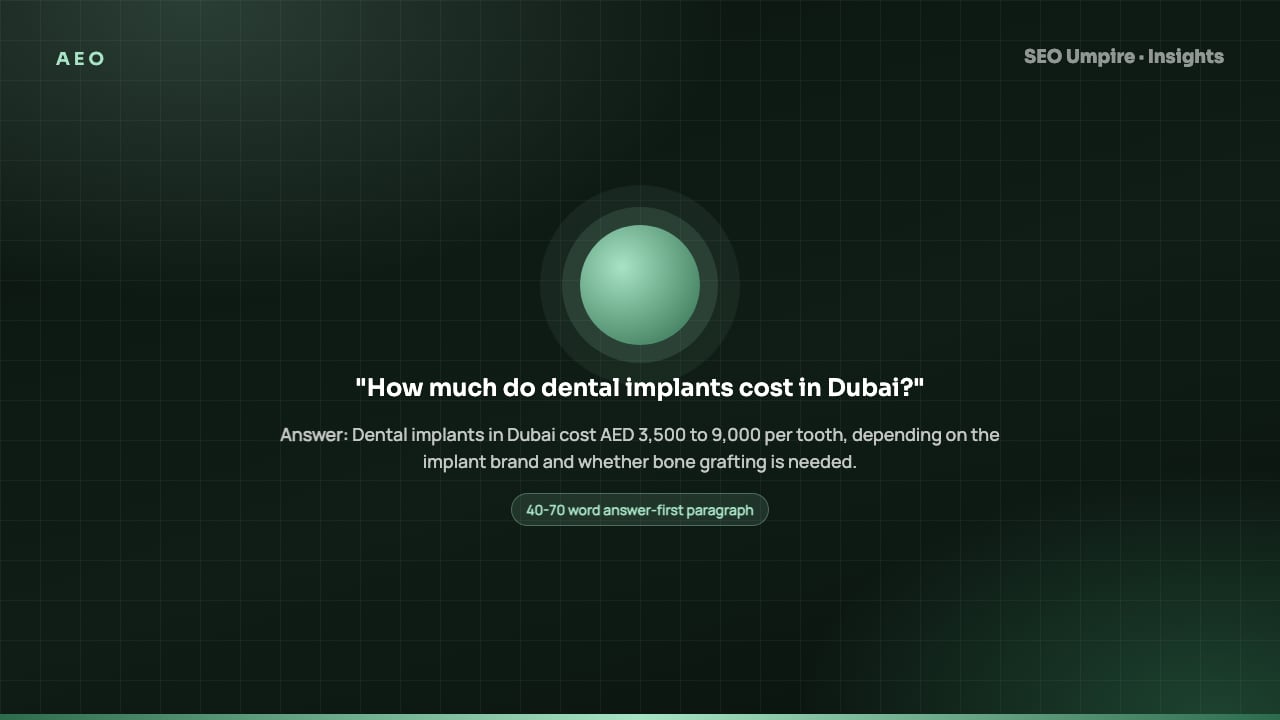
- Answer in the first sentence. The paragraph directly under the heading should answer completely in 40 to 60 words. Lead with the subject and the fact: "An SEO audit costs between X and Y for a small site because..." Then elaborate in the following paragraphs.
- Use the matching format. Steps get an ordered list. Comparisons get a table with a header row. Definitions get a single paragraph. Quantities get a number in the first sentence, with units.
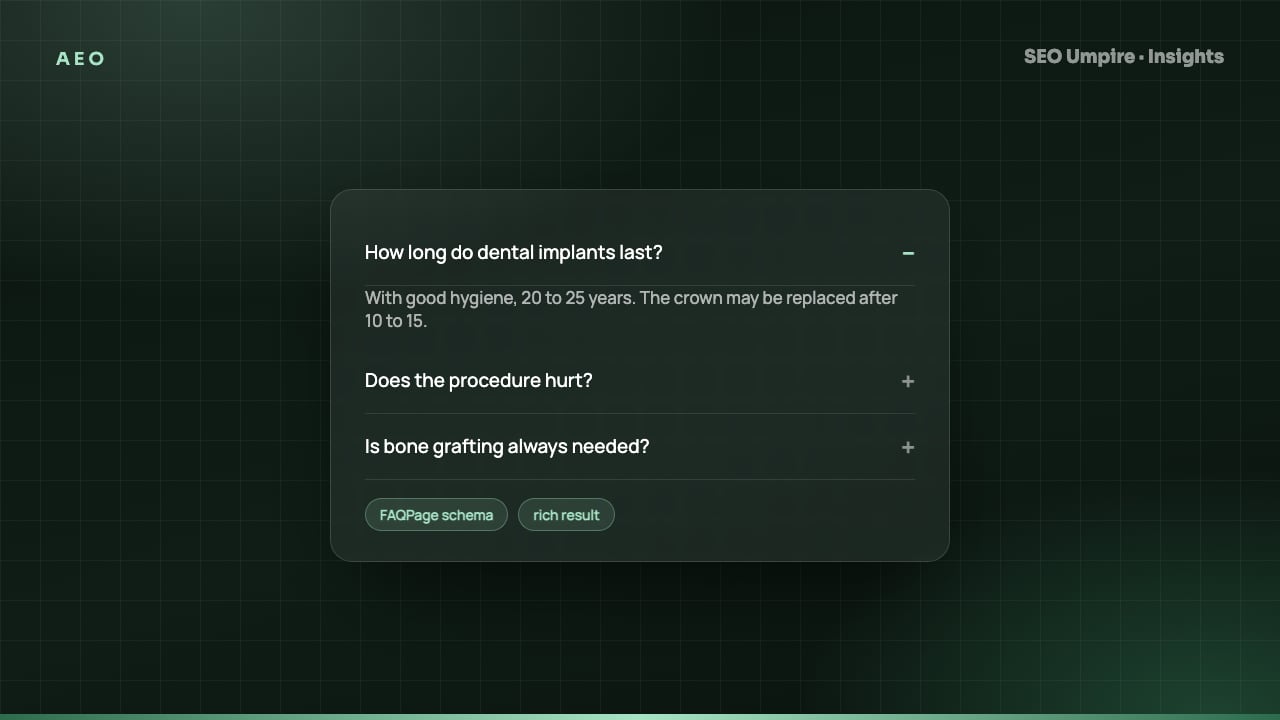
- Add an FAQ section. Three to six genuine follow-up questions, each with a one-to-three-sentence answer, mirrored in FAQPage JSON-LD. The FAQ schema guide shows the markup.
- Mark up the page. Article or BlogPosting with author and dates, plus FAQPage or HowTo where the content fits. Validate it; a broken schema block is ignored.
- Earn and keep authority. Engines prefer passages from sites they already trust: cited by others, with clear authorship, an about page, contact details and consistent facts across pages.
AEO content formats compared
| Question type | Best format | Length of the core answer | Typical surface |
|---|---|---|---|
| What is X | Definition paragraph | 40 to 60 words | Paragraph snippet, voice answer, AI citation |
| How to X | Numbered steps with a one-line intro | 5 to 9 steps, each under 20 words in the list | List snippet, HowTo rich result |
| X vs Y | Comparison table plus a one-sentence verdict | 3 to 6 rows | Table snippet, AI comparison answer |
| How much / how long | A number with units in sentence one, then context | 1 to 2 sentences | Paragraph snippet, voice answer |
| Best X for Y | Ranked list with one-line reasons | 5 to 10 items | List snippet, AI recommendation |
| Is X / Can X / Does X | Yes or no, then the condition | 1 to 2 sentences | Paragraph snippet, voice answer |
What technical requirements does AEO have?
Everything that applies to SEO applies here, because an unindexed page cannot be an answer. On top of that:
- Server-render the answer. If the passage only appears after client-side JavaScript runs, some engines will never see it. Check with a free SEO checker, which shows what the raw HTML contains.
- Keep the answer near the top of the DOM. Long cookie banners, navigation menus and hero sliders before the content push the answer down and reduce extraction confidence.
- Use real HTML structure.
<h2>,<ol>,<table>tags, not divs styled to look like them. - Do not block AI crawlers unless you mean to. Check
robots.txtfor rules against GPTBot, PerplexityBot, ClaudeBot or Google-Extended if you want to appear in those tools. An llms.txt file can also point AI crawlers to your best content. - Keep facts consistent. If your pricing page says one figure and your FAQ says another, engines lower their confidence in both.
How do you measure AEO?
Average position hides AEO results, because a featured snippet is "position 1" and a cited AI answer does not appear in classic rank data at all. Track these instead:
- Featured snippet and People also ask ownership per target question, checked weekly in a rank tracker that records SERP features
- Impressions and click-through rate for question queries in Google Search Console; a snippet usually raises impressions sharply and may lower CTR for simple questions
- AI citation share: how often ChatGPT, Perplexity and AI Overviews cite your domain for a fixed set of prompts, checked monthly
- Branded search growth, which usually follows sustained AI and snippet visibility even when direct clicks fall
SEO Umpire's audit flags pages that have question headings without a direct answer beneath them, and its Umpire Agent can draft the answer paragraph and FAQ block for review.
Common AEO mistakes
- Burying the answer after a 300-word introduction
- Phrasing headings as clever statements instead of the question people type
- Writing FAQ answers that say "contact us to find out"
- Adding FAQPage markup for questions that are not visible on the page
- Optimizing for the snippet and forgetting the rest of the page, so users who do click find nothing more
Frequently asked questions
What is answer engine optimization?
Answer engine optimization is the practice of structuring content so that search engines, voice assistants and AI chat tools can extract and present it as the direct answer to a question, instead of merely listing the page as a link.
How is AEO different from SEO?
SEO aims to rank a page in a list of results. AEO aims to have a specific passage from the page selected as the answer shown above or instead of that list. AEO builds on SEO; a page still has to be crawlable and authoritative to be chosen.
Does AEO reduce clicks to my website?
It can lower clicks for simple factual queries, but featured snippets and AI answers that cite you typically increase brand visibility and capture the clicks for complex queries where the user wants more detail.
What content formats work best for AEO?
Short definition paragraphs, numbered step lists, comparison tables and FAQ sections. Each matches a format that engines already present as snippets or spoken answers.
Free audit, 32 checks, prioritized fixes and a PDF report in about 15 seconds. No signup.
Keep reading
 AEO
FAQ Schema: How to Win Featured Snippets and AI Answers
FAQ schema is FAQPage JSON-LD marking up visible question and answer pairs so Google, ChatGPT and Perplexity can quote them. Setup, writing format, validation.
 AEO
SEO vs AEO vs GEO: Differences, Overlap and Which to Use
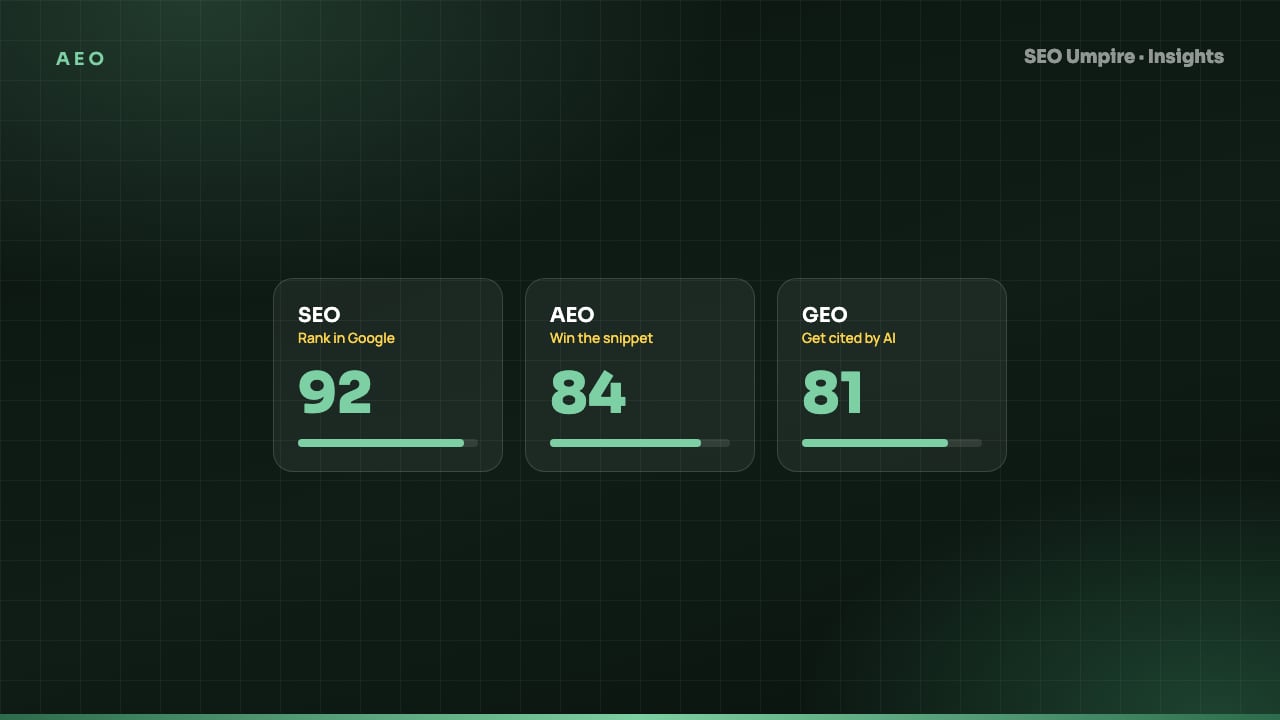
SEO ranks pages in results, AEO wins the extracted answer box, GEO earns citations inside AI answers. Compare goals, tactics and metrics side by side.
 SEO Basics
Competitor SEO Analysis: A 7-Step Process to Find Keyword Gaps
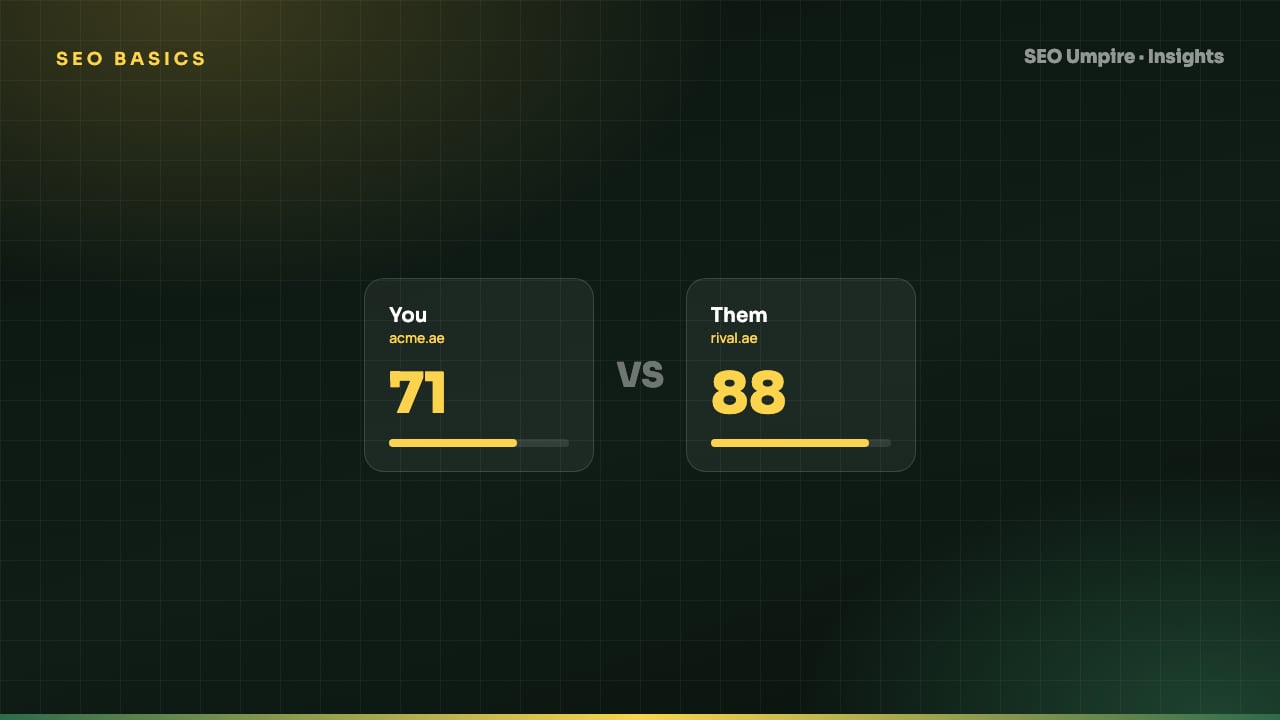
Competitor SEO analysis in 7 steps: find your real search competitors, run a keyword gap analysis, compare content, technical health, links and AI citations.
One short email a week: what changed in Google and AI answers, and the fixes that matter. No spam, unsubscribe any time.