

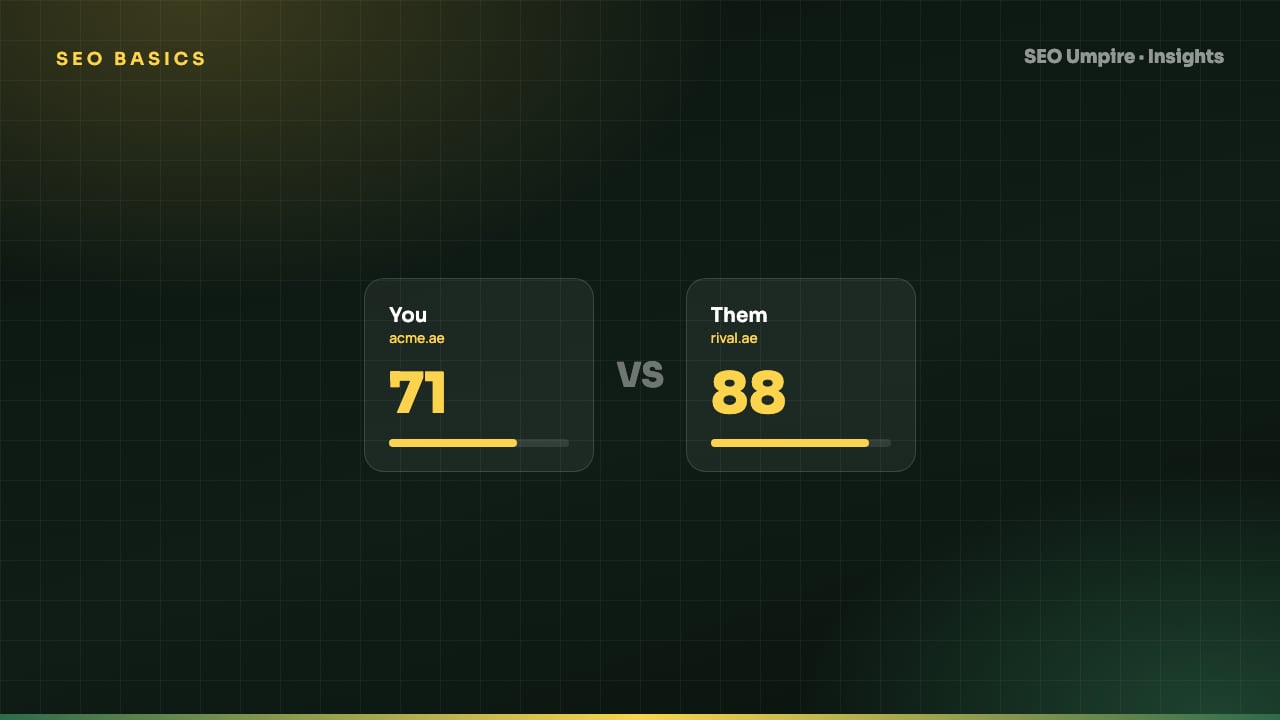
Competitor SEO Analysis: A 7-Step Process to Find Keyword Gaps
Competitor SEO analysis in 7 steps: find your real search competitors, run a keyword gap analysis, compare content, technical health, links and AI citations.
Competitor SEO analysis is the process of finding out which sites actually rank for the searches you want, then comparing their keywords, content, technical health, structured data, backlinks and AI-search citations against yours to find gaps you can close. Done properly it replaces guesswork with a prioritized plan: pages to create because a competitor proves the demand, pages to improve because a competitor shows what "better" looks like, and technical or authority gaps that explain why they rank and you do not.
This guide gives a seven-step process you can run in a day and repeat quarterly, with the specific things to compare at each step.
Who are your SEO competitors?
Your search competitors are whoever occupies the results for your keywords, not necessarily the companies you compete with for customers. A regional law firm competes in search with national legal directories, publishers and government sites. A software company competes with review platforms and blogs.
To find them:
- List your 20 to 30 most important keywords from the keyword research tool and Search Console.
- Search each one (in the right country, in a clean browser session) and record the top ten domains.
- Count how often each domain appears. The five to eight domains that appear most are your SEO competitors.
- Split them into two groups: direct business rivals and non-rival ranking competitors (publishers, directories, marketplaces). You will learn different things from each.
Step 1: Benchmark visibility
Before comparing anything, record the baseline so you can measure change.
- Share of voice across the keyword set: how many of the top ten positions each competitor holds.
- Number of your target keywords where each competitor ranks in the top three, top ten and top twenty.
- Estimated organic traffic trend over 12 months.
Set these keywords up in the rank tracker with competitors added so the benchmark updates daily instead of once per analysis.
Step 2: Run a keyword gap analysis
The keyword gap is the list of terms competitors rank for and you do not, or you rank far below them. It is the single most useful output of the whole exercise.
- Export each competitor's ranking keywords (positions 1 to 20).
- Remove their brand terms and anything irrelevant to your business.
- Mark each term as: competitor ranks and you do not; both rank but they are higher; only you rank.
- Score the gaps by volume, intent and difficulty.
- Group them into topics; a cluster of 15 gaps around one subject is a content hub, not 15 posts.
Check demand and difficulty by market with keyword research by country if you sell in more than one.
| Gap type | What it tells you | Action |
|---|---|---|
| Competitor ranks, you have no page | Missing content with proven demand | Create a page targeting the cluster |
| Both rank, competitor higher | Your page is weaker on content, links or technical | Improve the existing page |
| Competitor ranks with a weak page | Easy win | Create a stronger page quickly |
| Only you rank | Your advantage | Defend with refreshes and internal links |
| Competitor ranks for question queries | AEO opportunity | Add answer-first sections and FAQ schema |
Step 3: Compare content page by page
For each important keyword where a competitor outranks you, open both pages and compare:
- Intent match. Does their page answer the query more directly? Is it a guide where yours is a product page, or the reverse?
- Depth and structure. Word count is not the metric; coverage is. Do they answer the follow-up questions (price, time, alternatives, risks)? Do they use tables, steps, FAQs?
- Freshness. When was it last meaningfully updated?
- Experience signals. Original photos, test data, named expert authors. See the E-E-A-T SEO guide.
- Answer-first formatting. Does the first paragraph answer the question? Are headings questions? This is what gets quoted by answer engines.
Record the gaps in a sheet with a one-line "what theirs has that ours lacks". That line is the brief for the rewrite.
Step 4: Compare technical health
A competitor's technical advantage is often invisible until you look.
- Run their key pages and yours through SEO Umpire's free SEO checker and compare scores by category.
- Check Core Web Vitals for both sites' main templates in PageSpeed Insights; a competitor passing on mobile while you fail is a measurable gap. See the Core Web Vitals SEO guide.
- Compare site architecture: how many clicks from their homepage to a money page versus yours.
- Check indexation: how many pages do they have indexed, and are they all useful? A lean competitor often beats a bloated one.
- Look at their internal linking: do category and hub pages link down to supporting content and back up?
Run a full site audit on your own site at the same time so the comparison is current.
Step 5: Compare structured data and rich results
Search for your keywords and note which competitors win FAQ dropdowns, star ratings, product prices, sitelinks or HowTo results. Then view their source and list the schema types they use. Common finds: FAQPage on service pages, Product with aggregateRating, Article with author, BreadcrumbList, Organization with sameAs links. Anything they have that you lack is a quick fix with the AI schema generator; the JSON-LD schema markup guide explains how to combine types correctly.
Step 6: Compare authority and links
Links still explain a large share of ranking differences for competitive terms.
- Count referring domains to each competitor's site and to the specific pages that outrank you.
- Look at the type of links: editorial mentions, directories, partners, press, resource pages, guest content.
- Find links that several competitors share and you do not; those sources already link to sites like yours and are the easiest to approach.
- Note their brand search volume relative to yours; brand demand is an authority signal you build through PR and product, not link requests.
Step 7: Compare AI-search citations
Classic rankings are half the picture. For your 20 highest-intent questions, ask ChatGPT, Perplexity and check Google AI Overviews, and record which domains are cited. Then compare:
- Which competitor pages get cited, and what format they use (definitions, numbers, steps, tables).
- Whether competitors publish an llms.txt file; see the llms.txt file guide.
- Whether they block or allow AI crawlers in robots.txt.
- How clearly their pages state facts a model can quote with attribution.
The playbook for closing this gap is in how to get cited by ChatGPT, Perplexity and AI Overviews.
Turning the analysis into a plan
Collect everything into three lists and prioritize each by expected impact against effort.
- Create: keyword clusters with proven demand and no page on your site. Order by volume times intent, discounted by difficulty.
- Improve: pages you have that a competitor beats, each with the one-line gap brief from Step 3 and the schema or technical fixes from Steps 4 and 5.
- Fix and build: site-wide technical issues, structured data gaps, link sources shared by competitors, llms.txt and answer-first formatting.
Assign dates, then measure against the Step 1 baseline. Share of voice and top-ten counts should move within one to two quarters for the "improve" list and two to three quarters for the "create" list; the how long does SEO take post sets realistic expectations.
Mistakes in competitor analysis
- Analyzing business rivals instead of the sites that actually rank
- Copying competitor content instead of exceeding it
- Chasing a competitor's total keyword count rather than the relevant gap
- Comparing domain-level authority scores and stopping there
- Ignoring non-rival ranking competitors (publishers, directories) that you could earn links or listings from
- Running it once and never updating; competitors move
A quarterly rhythm
Full analysis every quarter, a light check monthly: new competitor pages for your top keywords, rank tracker share of voice, and a spot check of AI citations for your five most valuable questions. Over a year this compounds into a map of exactly where you win, where you lose and why, which is the only basis for an SEO plan that is not guesswork.
Frequently asked questions
What is competitor SEO analysis?
Competitor SEO analysis is the process of identifying which sites rank for your target keywords and comparing their keywords, content, technical setup, structured data, backlinks and AI-search citations with yours to find gaps you can close and advantages you can press.
How do I find my SEO competitors?
Search your 20 to 30 most important keywords and record which domains appear in the top ten repeatedly. Those are your search competitors. They often include publishers, directories and marketplaces rather than only direct business rivals.
What is a keyword gap analysis?
A keyword gap analysis lists the keywords one or more competitors rank for that your site does not, or ranks for much lower. Filtering that list by relevance, volume and difficulty produces a content plan with demand already proven by a competitor.
How often should I run a competitor analysis?
A full analysis quarterly and a light check monthly. Competitors publish, update and earn links continuously, and AI-search citations shift faster than classic rankings.
Free audit, 32 checks, prioritized fixes and a PDF report in about 15 seconds. No signup.
Keep reading
 SEO Basics
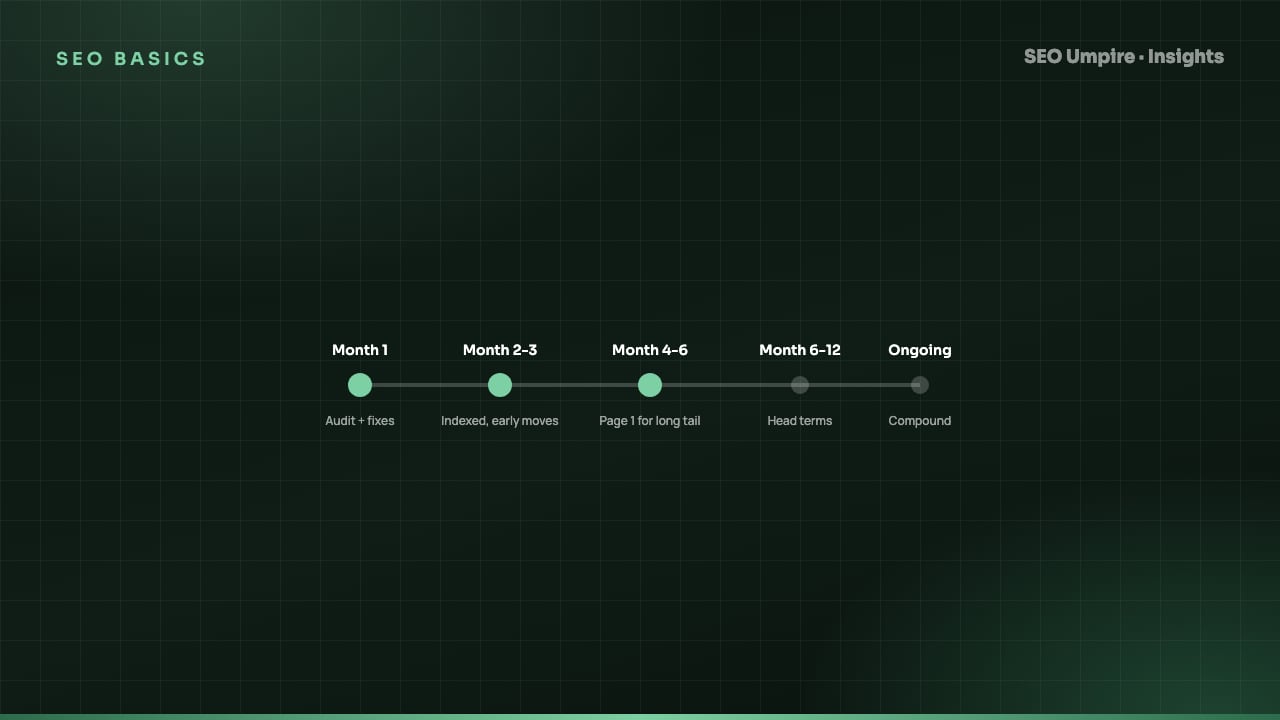
How Long Does SEO Take? Realistic Timelines by Site Type
How long does SEO take? Usually 3 to 6 months for measurable gains and 6 to 12 for competitive keywords. Timelines by site type and tactic, month by month.
 SEO Basics
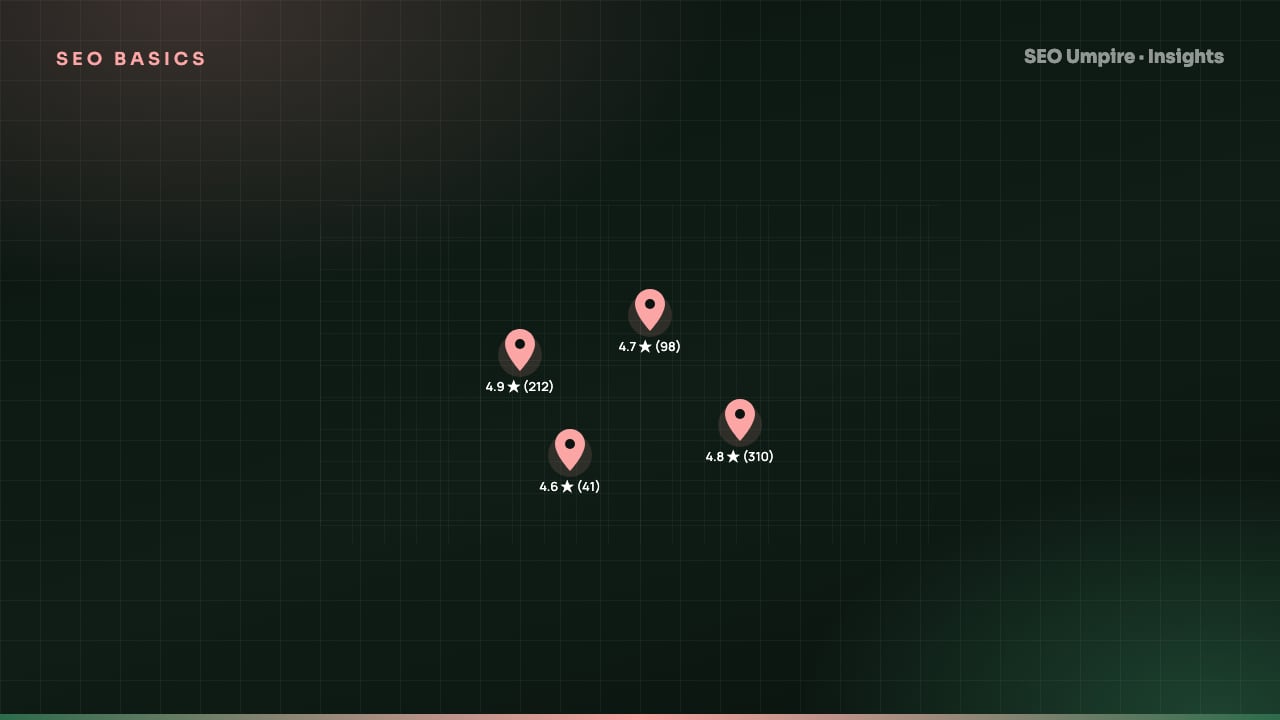
Local SEO Guide: How to Rank in the Map Pack and Local Results
Local SEO explained: how Google ranks the map pack on relevance, distance and prominence, with steps for Business Profile, reviews, citations and schema.
 SEO Basics
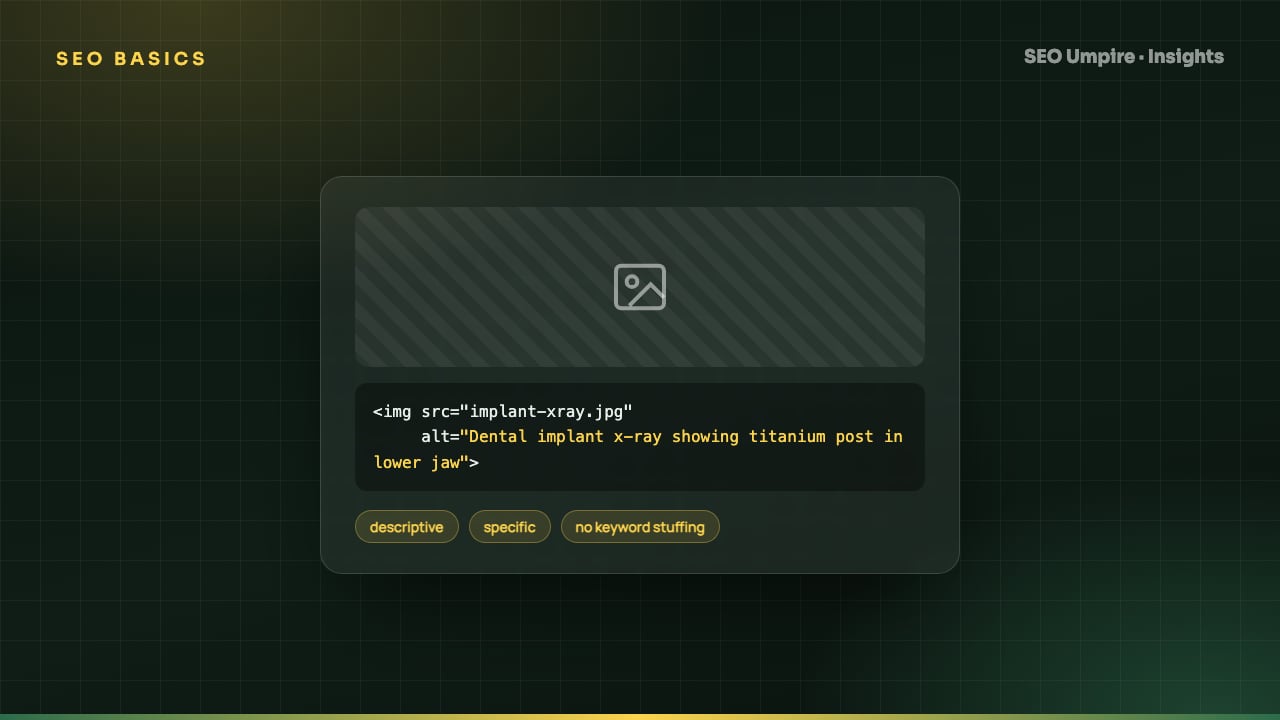
Image Alt Text SEO: How to Write Alt Text That Ranks
Image alt text is the HTML alt attribute describing an image for screen readers and search engines. How to write it, when to leave it empty, and full image SEO.
One short email a week: what changed in Google and AI answers, and the fixes that matter. No spam, unsubscribe any time.