

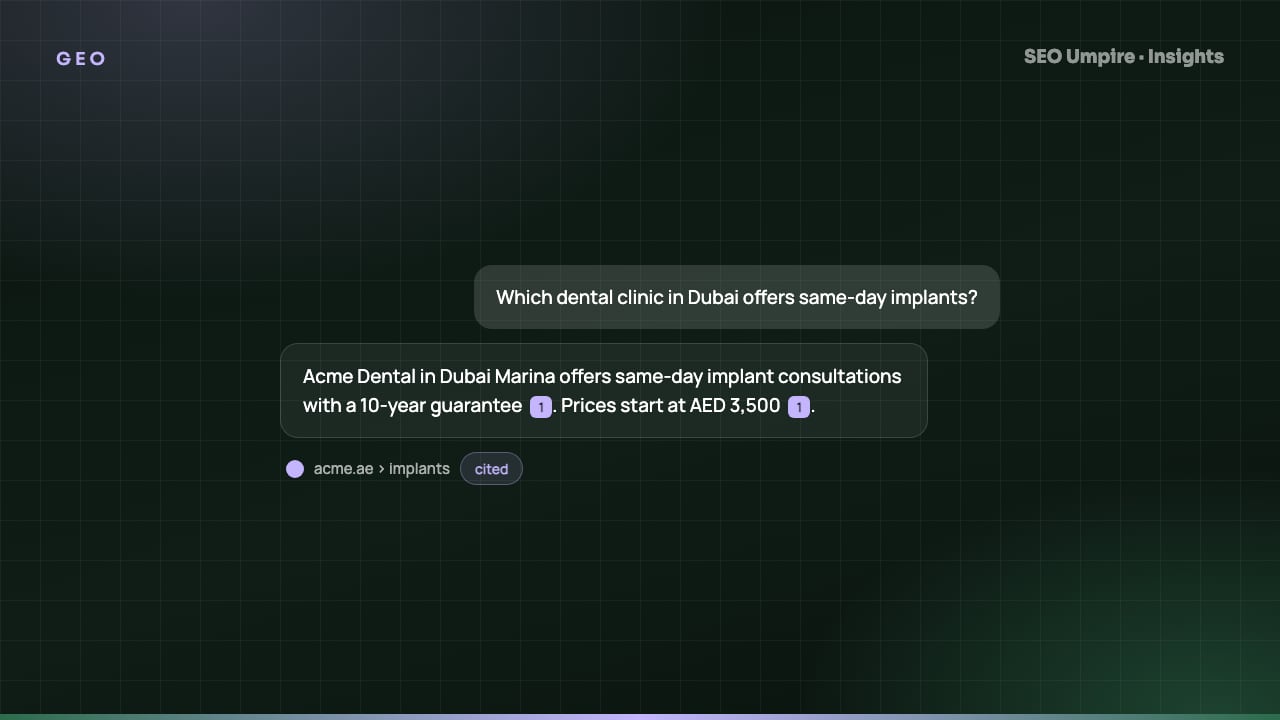
Get Cited by ChatGPT, Perplexity and AI Overviews: A Guide
To get cited by ChatGPT, Perplexity and AI Overviews: rank for retrieval queries, allow their crawlers and write specific, sourced, quotable passages.
To get cited by ChatGPT, Perplexity and Google AI Overviews you need to pass two filters: the engine's retrieval layer has to find your page (which means ranking for the queries it runs behind the scenes and allowing its crawler), and the language model then has to judge your passage the clearest, most specific support for its answer. Practically, that means allowing OAI-SearchBot, PerplexityBot and Googlebot in robots.txt, ranking for question-shaped queries, and writing one-sentence facts with numbers, names and sources that a model can quote without rewriting.
This guide explains how each of the three engines picks sources, the shared tactics that work across all of them, and a measurement routine so you know whether it is working.
How does each AI engine find and cite sources?
The three engines look similar to users but differ underneath. The differences decide where to focus.
ChatGPT (and Microsoft Copilot)
When browsing or search is enabled, ChatGPT turns the user's prompt into one or several search queries and sends them to a web index, predominantly Bing. It fetches the top results with the OAI-SearchBot user agent (distinct from GPTBot, which collects training data), reads them, and cites the pages whose passages support the final answer. Three implications:
- Bing rankings matter. If you have never looked at Bing Webmaster Tools, start; a site that ranks on Google but is poorly indexed on Bing will be under-cited in ChatGPT.
- Reformulated queries matter. The model rarely searches for the user's exact words. It searches for the sub-questions. A page that covers the sub-questions under their own headings gets retrieved more often.
- Blocking GPTBot does not block citations, but blocking OAI-SearchBot does. Many sites block both with a single copied rule and vanish from ChatGPT answers.
Perplexity
Perplexity runs its own crawler (PerplexityBot) and index, supplemented by partner search data. It shows citations prominently, usually four to eight per answer, and favors recency. Observed behavior: it cites mid-ranking pages more readily than Google does when those pages have a clearly bounded answer, and it penalizes slow or JavaScript-dependent pages by simply failing to extract them. It also surfaces "related questions", so covering follow-ups on the same page increases the chance of repeat citation within one session.
Google AI Overviews
AI Overviews are generated from Google's own index and lean heavily on pages that already rank in the top results for the query and its sub-queries. Google has stated that the usual ranking systems feed them, and that there is no separate markup to opt in beyond normal indexing. Google-Extended in robots.txt controls Gemini training, not whether you appear in AI Overviews; standard Googlebot access does. Pages with question headings, direct answers and valid Article or FAQPage schema are over-represented in the citations.
Engine comparison
| Factor | ChatGPT / Copilot | Perplexity | Google AI Overviews |
|---|---|---|---|
| Retrieval index | Bing (mainly) | Own index plus partners | |
| Crawler to allow | OAI-SearchBot (Bingbot for the index) | PerplexityBot | Googlebot |
| Training opt-out (separate) | GPTBot | Not separate | Google-Extended |
| Typical citations per answer | 3 to 6 | 4 to 8 | 3 to 8, in a carousel |
| Recency weight | Moderate | High | Moderate |
| JavaScript rendering | Limited | Limited | Full |
| Best content shape | Direct answers to sub-questions | Short, dated, specific passages | Question headings plus schema |
| Where to check your presence | Bing Webmaster Tools, manual prompts | Manual prompts | Search Console (impressions), manual queries |
How to get cited: 10 steps
- Audit crawler access. Open
robots.txtand confirmOAI-SearchBot,PerplexityBot,GooglebotandBingbotare not disallowed. Decide separately aboutGPTBot,ClaudeBotandGoogle-Extended, which govern training. Run the site through a site audit to catchnoindextags and canonical errors that break retrieval. - Get indexed on Bing. Verify the site in Bing Webmaster Tools, submit the sitemap, and fix any crawl errors. This alone moves ChatGPT visibility for many sites.
- Map the sub-questions. For each target topic, list the five to ten questions an AI would need to answer to respond well. Use keyword research and People also ask data. These become your H2 headings.
- Rank for them conventionally. Everything in the on-page SEO checklist still applies. A page in position 40 is never retrieved.
- Open with an entity statement. The first paragraph names the subject, defines it and gives the key fact. The model needs to know what the page is about within the first 100 words.
- Write quotable sentences. One fact per sentence. Subject, number, unit, condition. "Google truncates title tags at about 600 pixels, roughly 50 to 60 characters" will be quoted; "titles should not be too long" will not.
- Source every claim. Link to the specification, the documentation, the dataset. Models rate passages with visible sourcing as more reliable, and the links help the retrieval layer classify the page.
- Add author, date and schema. A named author with a bio, visible published and updated dates, and Article plus FAQPage JSON-LD. The JSON-LD guide explains the types.
- Make the same facts appear elsewhere. Models weigh corroboration. Consistent descriptions of your company and products on directories, partner sites, review platforms and social profiles raise confidence in your own page.
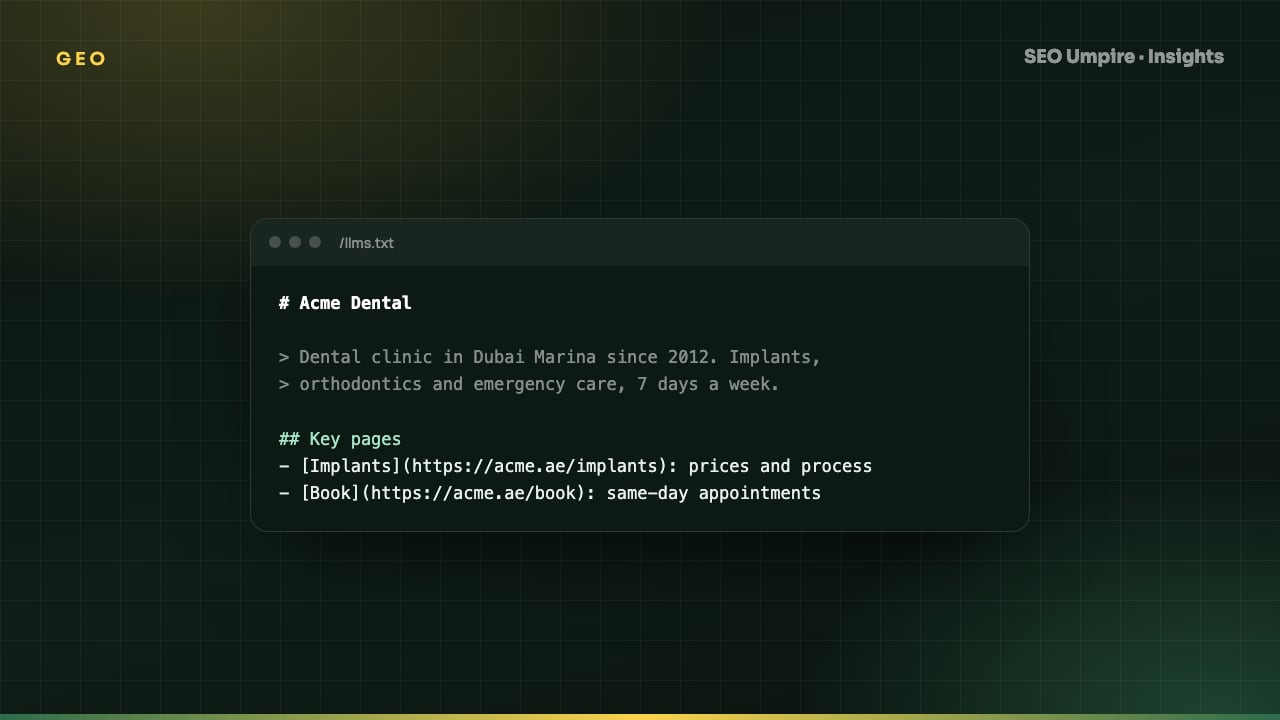
- Publish an llms.txt. It is advisory, but it costs 30 minutes and points AI tools to your canonical pages. See the llms.txt guide.
What kind of content gets cited most often?
Across all three engines the patterns are consistent:
- Definitions with a one-paragraph answer at the top
- Numbers: benchmarks, thresholds, prices, dates, with units and a date of measurement
- Comparisons laid out in a table with a short verdict
- Step lists for how-to questions
- Original data: surveys, tests, case studies with method described
- Documentation and specs for product questions
Content that rarely earns citations: opinion without evidence, news summaries that repeat other sources, pages where the answer is in an image or video with no transcript, and generic AI-written text, which models recognize as adding nothing new.
What technical issues silently prevent citations?
- Client-side rendering. If the answer is injected by JavaScript, ChatGPT and Perplexity may see an empty page. Confirm the raw HTML with a free SEO checker.
- Slow servers. Crawlers time out. Keep time-to-first-byte well under a second.
- Answers hidden in accordions, tabs or "read more" toggles that only render on click.
- Aggressive bot protection that serves a challenge page to AI crawlers. Whitelist the agents you want.
- Changed URLs without redirects. A citation is a URL; break it and the engine learns to distrust the domain.
- Duplicate versions of the same page splitting the signal between URLs.
How do you measure AI citations?
There is no official dashboard, so build a simple routine:
- Write 25 to 50 prompts your customers would ask, covering definitions, comparisons, recommendations and troubleshooting.
- On a fixed day each month, run every prompt in ChatGPT (search on), Perplexity and Google (looking for an AI Overview), from a logged-out or clean session.
- Record per prompt and engine: cited (yes or no), the URL cited, position among citations, and the sentence describing you.
- Calculate citation share per engine: prompts where you were cited divided by total prompts.
- In analytics, segment referral traffic from
chatgpt.com,perplexity.ai,copilot.microsoft.comandgemini.google.com. - Watch branded search in trends and Search Console. Sustained AI visibility usually lifts it within a quarter.
Report citation share alongside rankings. A drop from position 1 to position 3 on Google while your citation share rises from 20 to 45 percent is a net gain. SEO Umpire's audit flags the structural issues above per page, and the Umpire Agent drafts entity statements, direct answers and schema so the fixes do not depend on a developer's calendar.
Common mistakes
- Blocking all AI user agents with a copied
robots.txtblock - Ignoring Bing entirely
- Headings that are statements, not questions
- Facts spread over paragraphs instead of stated in one sentence
- No author, no dates, no sources
- Checking once, seeing no citation and giving up; the retrieval layer needs weeks to recrawl and rerank
Frequently asked questions
How does ChatGPT decide which websites to cite?
When browsing is on, ChatGPT runs web searches (largely through Bing), reads the top candidate pages and cites the passages that most directly support its answer. Pages that rank for the reformulated queries and state facts plainly are cited most.
How do I get my website on Perplexity?
Allow PerplexityBot in robots.txt, make sure pages are fast and server-rendered, rank for the question in conventional search, and open each page with a specific, quotable answer. Perplexity cites several sources per answer, so mid-ranking pages with clearer passages often win.
How do I appear in Google AI Overviews?
Rank in the top results for the query or its sub-questions, structure the page with question headings and direct answers, and use Article and FAQPage schema. AI Overviews draw mostly from pages Google already ranks highly.
Can I pay to be cited by AI tools?
No. Citations in ChatGPT, Perplexity and AI Overviews are organic. Sponsored placements exist separately in some tools but are labeled as ads and do not affect which sources the answer cites.
Free audit, 32 checks, prioritized fixes and a PDF report in about 15 seconds. No signup.
Keep reading
 GEO
llms.txt: What It Is, Format, and How to Create One
llms.txt is a Markdown file at your site root that tells AI tools which pages matter and how to read them. Learn the format, see an example and create yours.
 GEO
Generative Engine Optimization (GEO): How to Get Cited by AI
Generative engine optimization (GEO) makes your content the source ChatGPT, Perplexity and AI Overviews cite. A practical guide to entities and citations.
 SEO Basics
Competitor SEO Analysis: A 7-Step Process to Find Keyword Gaps
Competitor SEO analysis in 7 steps: find your real search competitors, run a keyword gap analysis, compare content, technical health, links and AI citations.
One short email a week: what changed in Google and AI answers, and the fixes that matter. No spam, unsubscribe any time.