

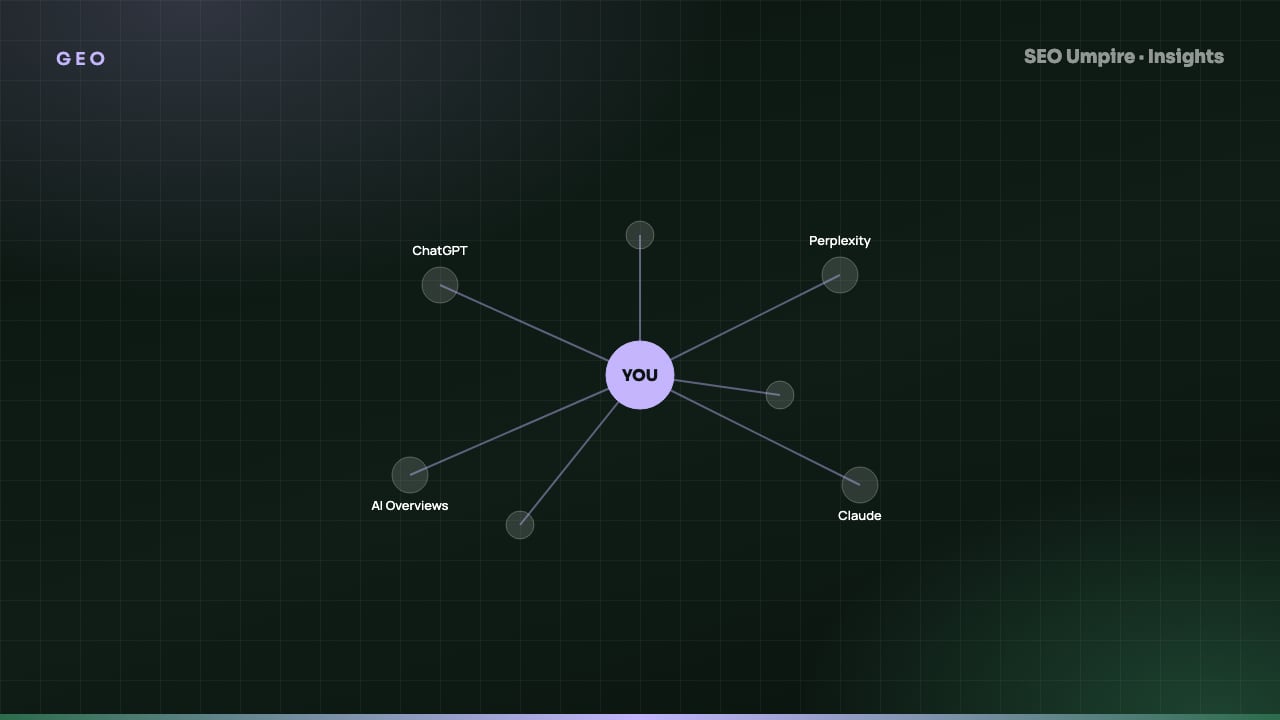
Generative Engine Optimization (GEO): How to Get Cited by AI
Generative engine optimization (GEO) makes your content the source ChatGPT, Perplexity and AI Overviews cite. A practical guide to entities and citations.
Generative engine optimization (GEO) is the practice of making your content the source that AI systems such as ChatGPT, Perplexity, Microsoft Copilot and Google AI Overviews retrieve, trust and cite when they generate an answer. It works by combining conventional SEO (so the page is found by the engine's search layer) with content written for machine extraction: unambiguous entity statements, specific figures with sources, quotable sentences and consistent facts that are corroborated on other websites. Where SEO competes for ten blue links, GEO competes for the three to eight citations a generated answer typically includes.
This guide explains how generative engines pick sources, what you can change on your site to influence that, and how to measure it.
How do generative engines choose what to cite?
Every major generative engine works in two stages, and you need to pass both.
Stage one is retrieval. When a user asks a question, the system runs one or more searches against a web index (Bing for ChatGPT and Copilot, Google for AI Overviews and Gemini, Perplexity's own index plus partners). It pulls back a set of candidate pages, typically the top results for several reformulations of the question. If your page does not rank for any of those reformulations, it is never seen. This is why GEO sits on top of SEO rather than replacing it.
Stage two is synthesis. The language model reads the candidate pages, decides which passages answer the question, writes a response and attaches citations to the passages it leaned on. Here the model favors passages that:
- State a fact plainly in one sentence that can be lifted without editing
- Include specific numbers, dates, names and definitions rather than generalities
- Agree with other retrieved sources, or explain clearly why they differ
- Come from a page whose topic and author are obvious from the first screen
- Are current, with a visible published or updated date
A page can rank well and still lose the citation to a lower-ranking page whose passage was simply easier to quote.
What is the difference between GEO, AEO and SEO?
The three overlap, and the labels matter less than the practices. In brief: SEO earns a position in a ranked list, AEO earns the extracted answer box, and GEO earns a citation inside a generated paragraph. The full comparison lays out the differences in targets, formats and metrics.
| Dimension | SEO | AEO | GEO |
|---|---|---|---|
| Target surface | Ranked results list | Featured snippet, voice answer, People also ask | Cited passage in an AI-generated answer |
| Unit of competition | The page | The passage under a heading | The claim and the entity behind it |
| Key signals | Relevance, links, technical health | Question heading plus direct answer, FAQ markup | Entity clarity, specificity, corroboration, freshness |
| Primary metric | Position, clicks | Snippet ownership, impressions | Citation share, brand mentions, referral traffic from AI tools |
How to do generative engine optimization: 9 steps
- Keep the SEO foundation solid. Crawlable, fast, indexed, with real headings. Run a site audit first; a page that fails retrieval never reaches the model.
- Allow the AI crawlers you want. Check
robots.txtforGPTBot,OAI-SearchBot,PerplexityBot,ClaudeBot,Google-ExtendedandBingbot. Blocking them removes you from the corresponding tools. Publish an llms.txt to point crawlers at your most citable pages. - Open every key page with an entity statement. The first paragraph should say what the thing is, who it is for and what makes it distinct, in plain declarative sentences. "SEO Umpire is a website SEO checker and AI SEO toolkit that..." is quotable. "Welcome to the future of search" is not.
- Write one-sentence facts. Scan each section for the sentence a model would lift. If a fact takes three sentences to assemble, rewrite it into one. Put the number, the unit and the condition together: "Google truncates title tags at about 600 pixels, roughly 50 to 60 characters."
- Cite your own sources. Link to the standard, documentation or dataset behind each claim. Models weigh passages that show their work, and the links also help the retrieval stage understand the topic.
- Show authorship and dates. A named author with a bio, a published date and an updated date in the visible HTML and in Article structured data. Stale pages lose to fresh ones on the same facts.
- Add structured data that describes the entity. Organization with
sameAslinks to your profiles, Person for authors, Product or SoftwareApplication for what you sell, Article for posts. The JSON-LD guide covers the types. - Get the same facts repeated elsewhere. Directory listings, review sites, partner pages, guest articles, Wikipedia-style references where legitimate. Models trust claims that appear in several independent places. Inconsistent descriptions of your company across the web actively hurt.
- Cover the question space, not just the head term. Generative engines reformulate queries. A page that answers the main question plus eight follow-ups, each under its own heading, gets retrieved for more reformulations. Use keyword research for the variants, draft the sections, then edit every line for accuracy.
Which content types get cited most?
Across the major engines the same formats keep appearing in citations:
- Definitions and explainers with a crisp first paragraph
- Comparison pages with a table and a reasoned verdict
- Statistics and benchmark pages that state a figure and its method
- Step-by-step guides with numbered lists
- Original research, surveys and case studies that no other page can replicate
- Product and pricing pages with concrete specs and numbers, for commercial questions
Opinion pieces, news without unique facts and thin landing pages are rarely cited because they add nothing the model cannot get elsewhere.
What technical details affect GEO?
- Server-side rendering. Several AI crawlers execute little or no JavaScript. Confirm the main content is in the raw HTML with a free SEO checker.
- Clean text extraction. Avoid putting the key answer inside tabs, accordions or carousels that render only on interaction, and keep tables as real
<table>elements. - Reasonable page weight and response time. Crawlers have fetch budgets and time-outs; a 6-second server response can mean a skipped page.
- Stable URLs. Citations are URLs. Every redirect or URL change risks breaking a citation a model has already learned.
- Canonical consistency. If the same text lives at three URLs, the citation is split and each copy looks less authoritative.
How do you measure GEO?
There is no Search Console for ChatGPT, so measurement is manual or tool-assisted:
- Build a fixed set of 20 to 50 prompts your customers would ask, from "what is" to "best X for Y" to "X vs Y".
- Run them monthly in ChatGPT (browsing on), Perplexity, Copilot and Google (for AI Overviews), from a clean session.
- Log for each prompt: whether you were cited, which URL, your position among citations, and how you were described.
- Track referral traffic from
chatgpt.com,perplexity.ai,copilot.microsoft.comandgemini.google.comin analytics. - Watch branded search volume; sustained AI visibility tends to lift it.
The number to improve is citation share: the percentage of prompts where you appear, broken down by engine. Treat a change in how the model describes you as seriously as a change in whether it cites you. The guide to getting cited goes deeper on each engine's behavior.
GEO mistakes that cost citations
- Blocking AI crawlers by default with a copied
robots.txtand wondering why you never appear - Vague first paragraphs that never state what the page or company is
- Facts without numbers, or numbers without units and dates
- Letting third-party descriptions of your business drift out of sync with your own
- Rewriting URLs during a redesign without redirects
- Publishing AI-generated text unedited, which tends to be generic and therefore unquotable
Frequently asked questions
What is generative engine optimization?
Generative engine optimization is the practice of making web content more likely to be retrieved, trusted and cited by AI systems that generate answers, such as ChatGPT, Perplexity, Copilot and Google AI Overviews.
Is GEO replacing SEO?
No. Generative engines use conventional search indexes to find candidate pages, so a page that cannot rank cannot be cited. GEO adds a layer of entity clarity and citation-friendliness on top of SEO.
How do I check if ChatGPT cites my website?
Ask it the questions your customers ask, with browsing enabled, and note which domains it cites. Repeat monthly with the same prompts and record the results in a sheet to see the trend.
Does blocking GPTBot hurt GEO?
Blocking GPTBot stops OpenAI from using your pages for training, and it also stops ChatGPT's browsing mode from fetching them, which removes you from live-cited answers. Decide deliberately.
Free audit, 32 checks, prioritized fixes and a PDF report in about 15 seconds. No signup.
Keep reading
 GEO
Get Cited by ChatGPT, Perplexity and AI Overviews: A Guide
To get cited by ChatGPT, Perplexity and AI Overviews: rank for retrieval queries, allow their crawlers and write specific, sourced, quotable passages.
 GEO
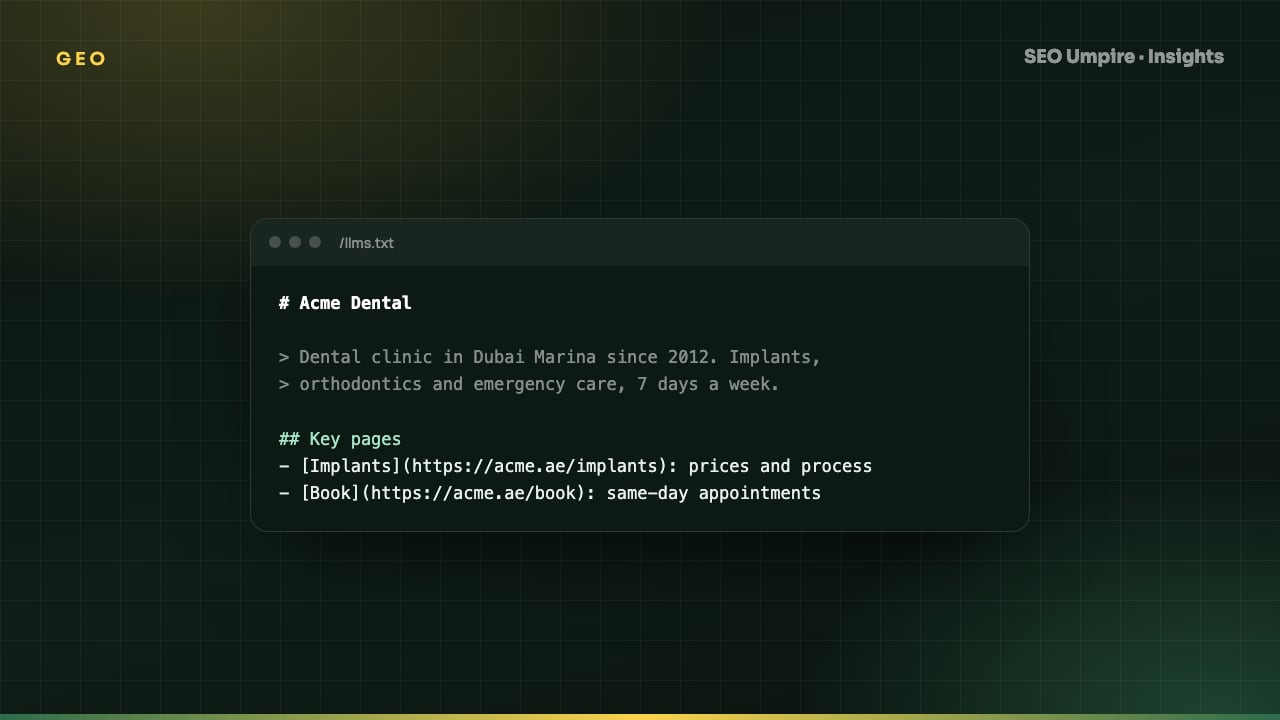
llms.txt: What It Is, Format, and How to Create One
llms.txt is a Markdown file at your site root that tells AI tools which pages matter and how to read them. Learn the format, see an example and create yours.
 SEO Basics
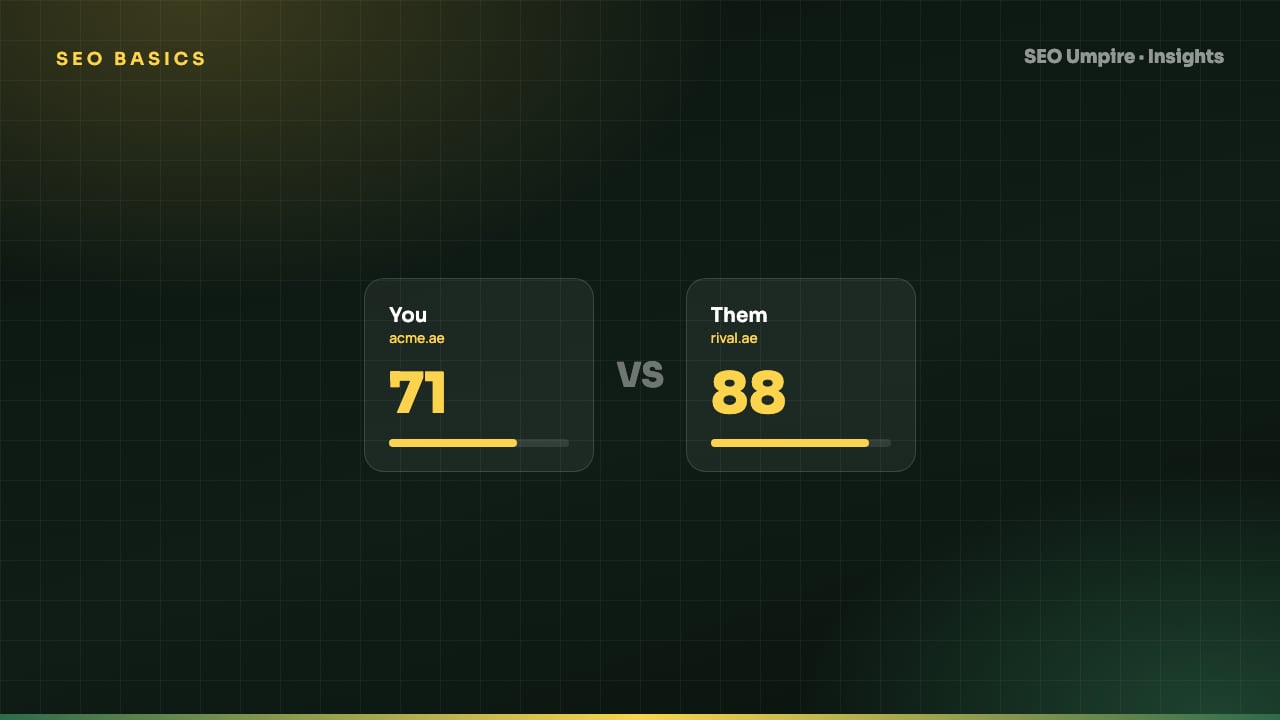
Competitor SEO Analysis: A 7-Step Process to Find Keyword Gaps
Competitor SEO analysis in 7 steps: find your real search competitors, run a keyword gap analysis, compare content, technical health, links and AI citations.
One short email a week: what changed in Google and AI answers, and the fixes that matter. No spam, unsubscribe any time.