
SEO vs AEO vs GEO: Differences, Overlap and Which to Use
SEO ranks pages in results, AEO wins the extracted answer box, GEO earns citations inside AI answers. Compare goals, tactics and metrics side by side.
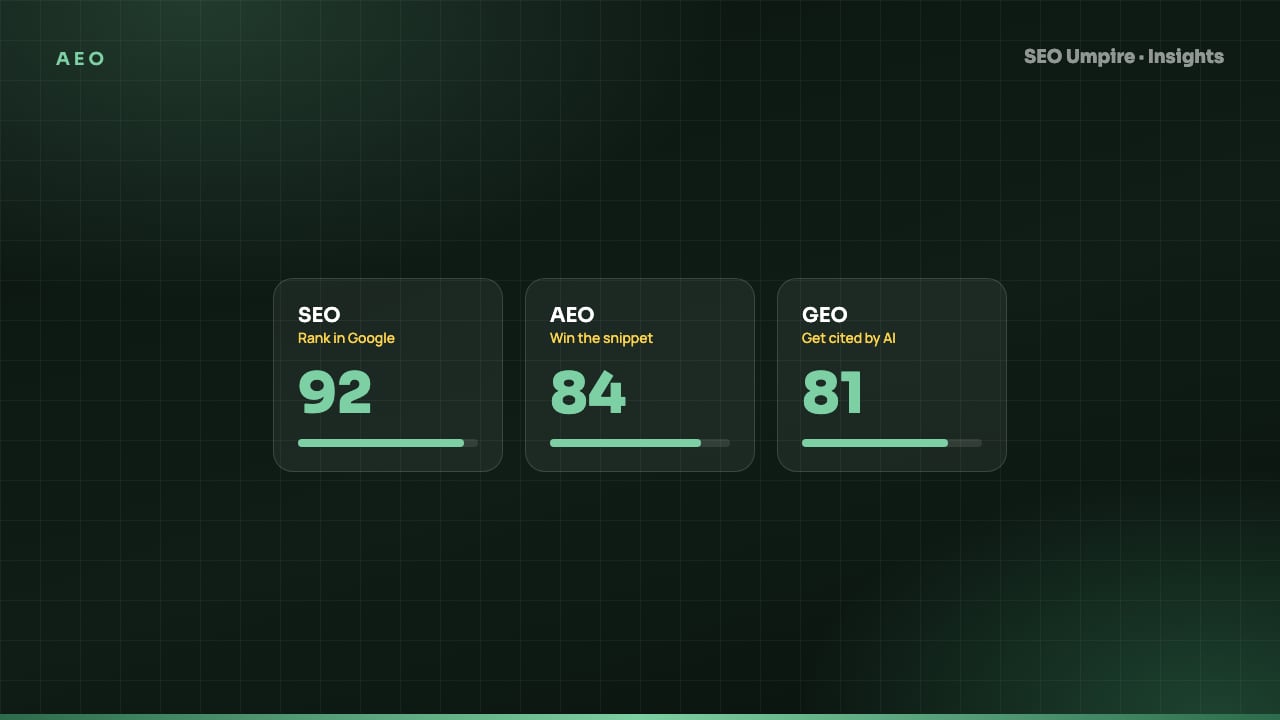
SEO, AEO and GEO differ in what they compete for. Search engine optimization (SEO) competes to rank a page in a list of results. Answer engine optimization (AEO) competes to have one passage from that page extracted as the direct answer in a featured snippet, People also ask box or voice response. Generative engine optimization (GEO) competes to have your claims and your brand cited inside an answer written by an AI model such as ChatGPT, Perplexity or Google AI Overviews. They stack: GEO depends on AEO-style structure, and both depend on SEO to be found at all.
This article compares the three on goals, tactics, formats and metrics, then shows how to build one page that serves all of them.
What does each term mean?
What is SEO?
Search engine optimization is the set of practices that make a page crawlable, indexable, relevant and authoritative so that it ranks for target queries. It covers technical health, on-page signals, content quality and backlinks. The output is a position on the results page and the clicks that follow. The SEO audit guide walks through what it checks.
What is AEO?
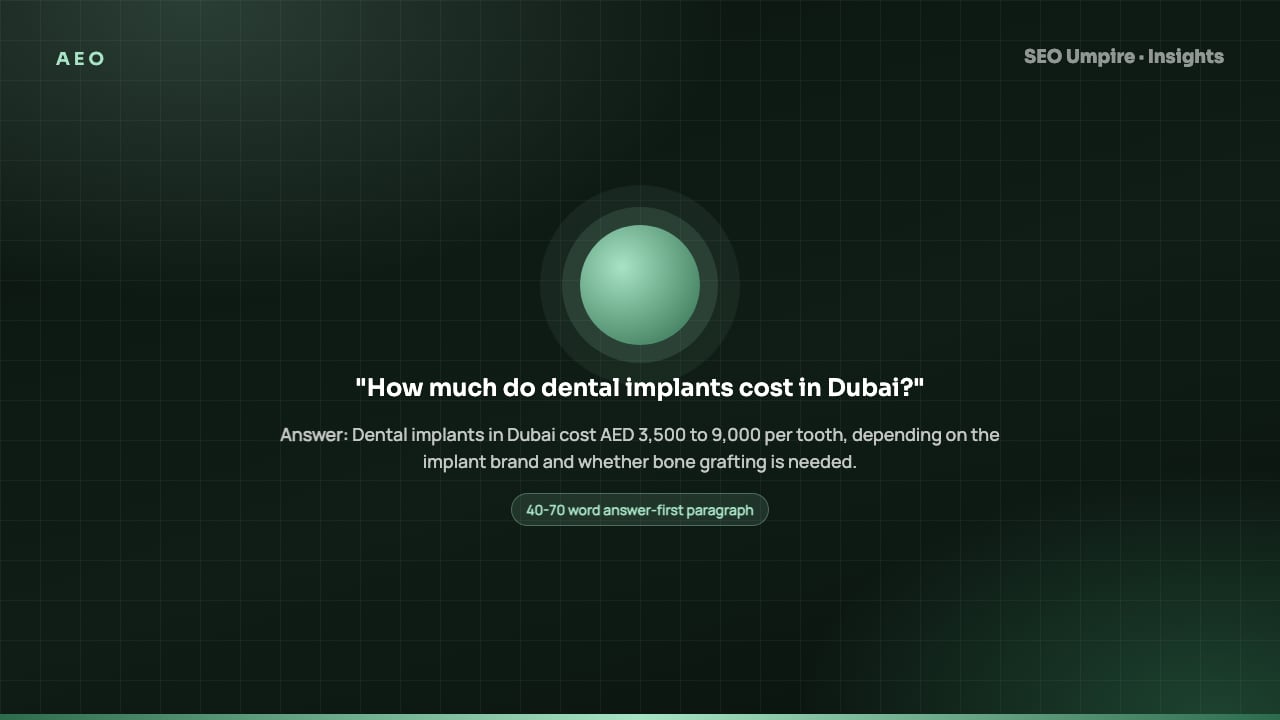
Answer engine optimization structures content so an engine can extract a specific passage as the answer. The classic surfaces are Google's featured snippets, People also ask boxes and voice assistant responses. The core technique is a question heading followed by a complete answer in the first 40 to 60 words, backed by FAQPage or HowTo markup. The AEO guide covers the method.
What is GEO?
Generative engine optimization makes your content likely to be retrieved and cited by large-language-model systems. These tools search the web, read several pages and write a synthesized answer with citations. GEO focuses on entity clarity (what exactly is this thing), specificity (numbers, dates, sources), corroboration (other sites saying the same) and quotability. The GEO guide explains how models choose sources.
SEO vs AEO vs GEO: side-by-side comparison
| Dimension | SEO | AEO | GEO |
|---|---|---|---|
| Goal | Rank the page | Be the extracted answer | Be cited in a generated answer |
| Surface | Organic results list | Featured snippet, People also ask, voice | ChatGPT, Perplexity, Copilot, AI Overviews, Gemini |
| Unit of competition | Page | Passage | Claim and entity |
| Query types | All | Questions, definitions, how-tos | Research, comparison, recommendation, "best X for Y" |
| Content shape | Comprehensive, intent-matched | Question heading plus direct answer, lists, tables | Entity statement, one-sentence facts with sources, consistent across the web |
| Structured data | Organization, Article, Product, BreadcrumbList | FAQPage, HowTo | Organization with sameAs, Person, Product, Article with author and dates |
| Authority signal | Backlinks, E-E-A-T | Ranking in the top 10 plus clear answer | Corroboration on third-party sites, author identity, freshness |
| Crawler | Googlebot, Bingbot | Googlebot | GPTBot, OAI-SearchBot, PerplexityBot, ClaudeBot, Google-Extended, Bingbot |
| Primary metric | Position, impressions, clicks | Snippet ownership, question-query impressions | Citation share, AI referral traffic, brand mentions |
| Typical result | Visitor clicks through | User reads the answer on the results page or hears it | User sees your brand as a source and may click the citation |
Where do they overlap?
Most of the work is shared. A page that is fast, indexed, well structured and authoritative is 80 percent of the way to all three. The differences are in the final 20 percent:
- SEO adds breadth and depth so the page is the best overall result.
- AEO adds the extracted answer: the question heading and the direct paragraph beneath it.
- GEO adds the quotable sentence: the specific, sourced claim that a model can lift verbatim, plus the entity clarity that lets the model know who said it.
Think of them as zoom levels on the same page rather than separate pages.
Where do they conflict?
Occasionally the three pull in different directions:
- Length. SEO often rewards comprehensive, long pages. AEO rewards a short, self-contained answer. The resolution is to put the short answer first and the depth after it.
- Click intent. AEO and GEO can satisfy the user without a click. For commercial pages that need the visit, structure the answer so it resolves the question but makes the next step (pricing, specs, a tool) obviously worth clicking. Many sites find that losing clicks on simple factual queries is offset by stronger brand recall and more clicks on complex ones.
- Crawler access. SEO only needs Googlebot and Bingbot. GEO needs the AI crawlers allowed, which some publishers block for licensing reasons. This is a business decision; make it consciously in
robots.txt.
Which should you prioritize?
It depends on where your audience is and what they ask.
- Start with SEO, always. Nothing else works if the page is not indexed and reasonably ranked. Run a site audit and fix blocking issues first.
- Add AEO when your queries are questions. If Search Console shows impressions for queries starting with how, what, why, which, can or does, and the results page shows snippets or People also ask boxes, structure those pages for extraction.
- Add GEO when your buyers research with AI. B2B software, professional services, technical products and anything involving comparison or recommendation are heavily researched in ChatGPT and Perplexity. Consumer impulse purchases less so.
- Local and transactional queries lean on SEO and AEO. Maps, store hours and "near me" queries are answered by Google's own features.
How to build one page that wins all three
Here is the structure a senior practitioner uses for an informational page:
- Title tag with the primary keyword at the front, under about 60 characters.
- Intro paragraph that answers the main question in two or three sentences and names the entity plainly. This serves AEO (the extractable answer) and GEO (the quotable statement) at once.
- H2 sections phrased as the questions people ask, each opening with a direct answer, then detail.
- At least one numbered list and one comparison table, because engines extract both formats well.
- Specific facts with sources: thresholds, prices, dates, named standards, linked to their origin.
- Author, published and updated dates visible on the page and in Article JSON-LD.
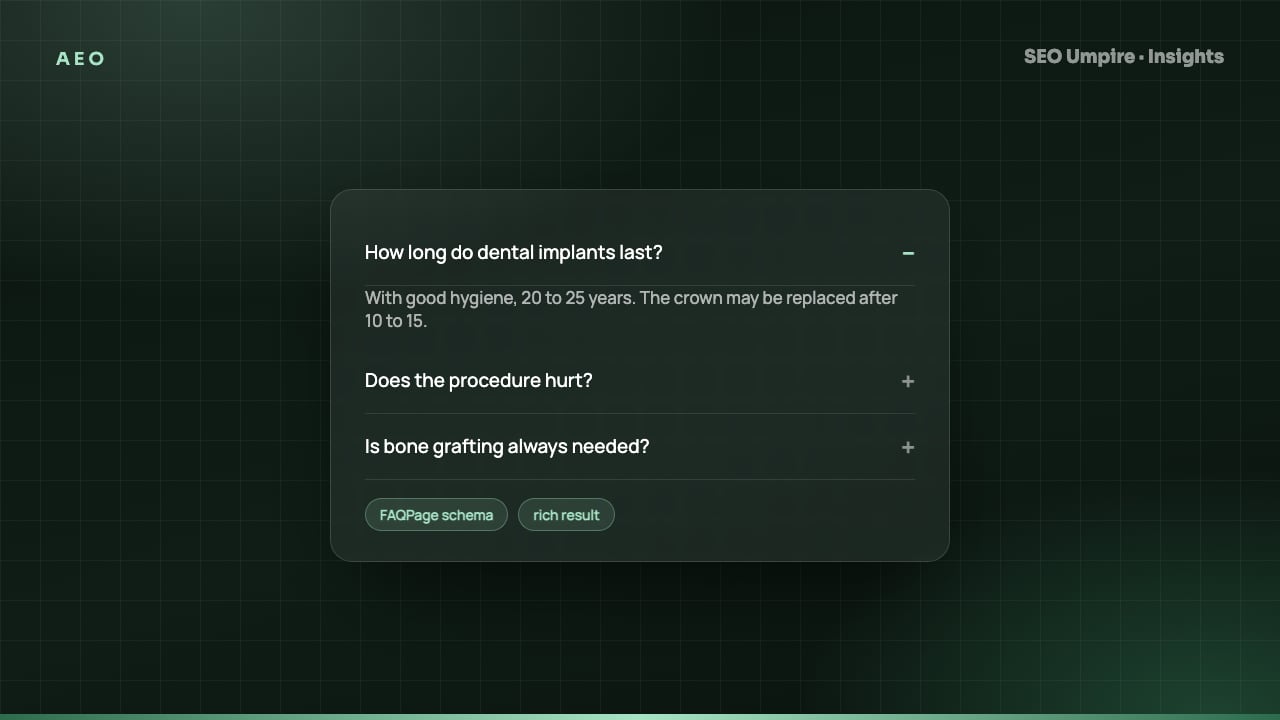
- FAQ section with three to five follow-up questions, mirrored in FAQPage markup.
- Internal links to the deeper pages and the tools that let the reader act.
SEO Umpire's audit scores each of these layers separately so you can see whether a page is failing at retrieval, extraction or citation, and the Umpire Agent drafts the missing answer paragraphs and schema for review.
How do you measure each layer?
- SEO: average position, impressions and clicks per query in Search Console, tracked daily in a rank tracker. Read the rank tracking guide for setup.
- AEO: which of your target questions you own the snippet or People also ask slot for, checked weekly. Impressions for question queries usually rise sharply when a snippet is won.
- GEO: a fixed prompt set run monthly across the main AI tools, logging citations, position among citations and how the model describes you, plus referral traffic from AI domains.
Report all three to stakeholders; a page that "dropped to position 2" may have lost the snippet to itself being quoted in an AI Overview, which is not a loss at all.
Frequently asked questions
What is the difference between SEO, AEO and GEO?
SEO optimizes a page to rank in a list of search results. AEO optimizes a passage to be extracted as the direct answer in a snippet or voice response. GEO optimizes claims and entities to be cited inside answers generated by AI models.
Do I need AEO and GEO if I already do SEO?
Yes, if your audience uses featured snippets, voice assistants or AI chat tools. SEO gets you retrieved, but without AEO and GEO structure another page's passage will be chosen as the answer.
Which is most important: SEO, AEO or GEO?
SEO is the prerequisite because the other two depend on being found. After that, prioritize AEO for informational queries with snippets and GEO for research and recommendation queries where users consult AI tools.
Can one page be optimized for all three?
Yes. Make it crawlable and authoritative (SEO), put a direct answer under each question heading with FAQ markup (AEO), and state specific, sourced facts about clearly named entities (GEO).
Free audit, 32 checks, prioritized fixes and a PDF report in about 15 seconds. No signup.
Keep reading
 AEO
FAQ Schema: How to Win Featured Snippets and AI Answers
FAQ schema is FAQPage JSON-LD marking up visible question and answer pairs so Google, ChatGPT and Perplexity can quote them. Setup, writing format, validation.
 AEO
Answer Engine Optimization (AEO): The Complete Guide
Answer engine optimization (AEO) structures content so featured snippets, voice assistants and AI engines quote it directly. The 8-step method and metrics.
 SEO Basics
Competitor SEO Analysis: A 7-Step Process to Find Keyword Gaps
Competitor SEO analysis in 7 steps: find your real search competitors, run a keyword gap analysis, compare content, technical health, links and AI citations.
One short email a week: what changed in Google and AI answers, and the fixes that matter. No spam, unsubscribe any time.