

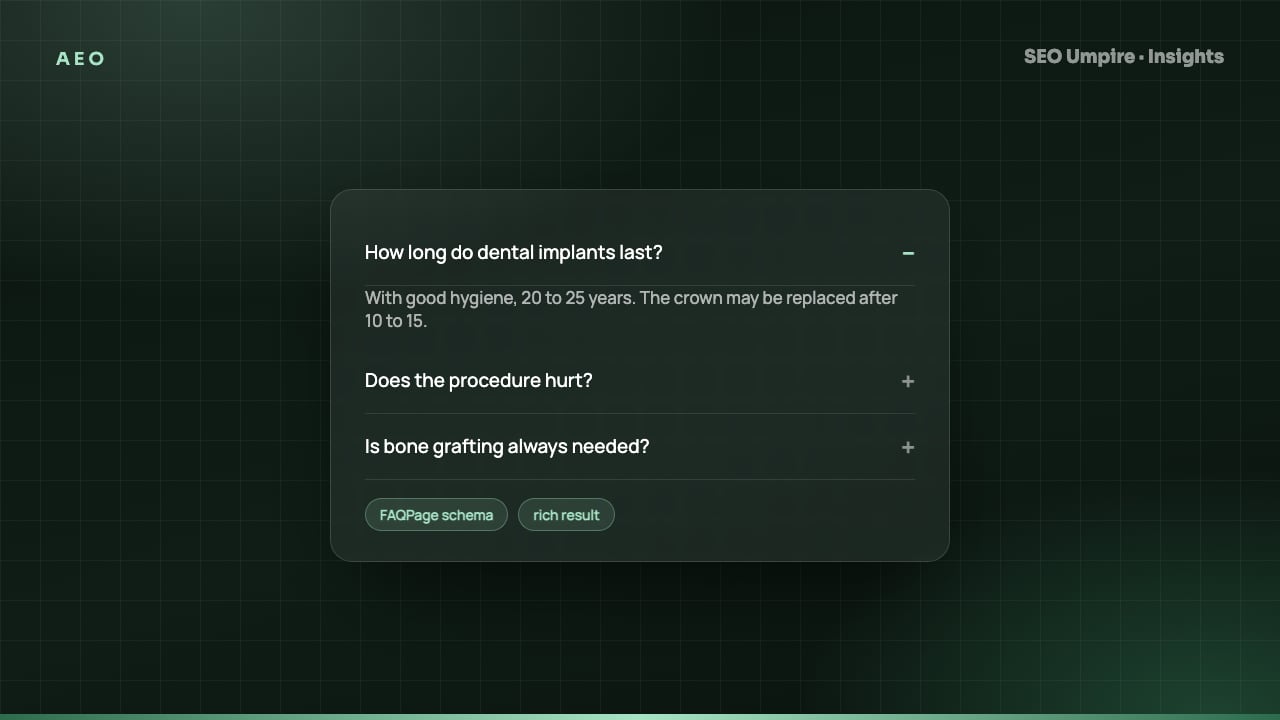
FAQ Schema: How to Win Featured Snippets and AI Answers
FAQ schema is FAQPage JSON-LD marking up visible question and answer pairs so Google, ChatGPT and Perplexity can quote them. Setup, writing format, validation.
FAQ schema is a block of FAQPage structured data (usually JSON-LD) that labels the question and answer pairs already visible on a page, so search engines and AI answer engines can extract each answer without guessing. In 2026 it rarely produces the expandable dropdowns in Google results it used to, but it remains one of the cheapest ways to earn People Also Ask placements, featured snippets and citations in ChatGPT, Perplexity and Google AI Overviews. Below is the exact markup, the writing format that gets lifted and the validation steps.
What is FAQ schema and what does it do?
FAQ schema uses the FAQPage type from schema.org. Each question is a Question entity with a name (the question text) and an acceptedAnswer of type Answer with a text property. Search engines read that block and map it to the visible content.
Three things happen when the markup is valid:
- Google can treat each Q&A pair as a candidate for People Also Ask boxes and featured snippets, because the answer boundaries are explicit.
- AI answer engines that crawl your page get clean, self-contained passages, which is what they prefer to quote. See our guide on how to get cited by ChatGPT, Perplexity and AI Overviews for the wider picture.
- The page gains an explicit entity graph: the FAQ can be linked to the
WebPage, theOrganizationand theArticlevia@idreferences.
What changed with FAQ rich results in 2023?
In August 2023 Google announced it would show FAQ rich results (the dropdowns under a listing) only for well-known, authoritative government and health websites. For everyone else the dropdowns disappeared. The markup was not deprecated, Google simply stopped rewarding it with visible real estate for most sites.
The practical implication: do not add FAQ schema expecting a bigger blue link. Add it because it makes your answers machine readable, which matters more every year as AI answer engines grow. Our AEO guide explains why passage-level clarity now drives visibility.
How do featured snippets and People Also Ask pick an answer?
Google selects a snippet by finding the passage that best answers the query, then checks whether it fits the display format: roughly 40 to 60 words for a paragraph snippet, up to 8 items for a list, and small tables of 3 to 5 columns. The passage is pulled from the page body, not from the schema, so the visible text has to be formatted for extraction.
FAQ schema helps because it confirms which heading is a question and where the answer starts and ends. When the visible heading, the schema name and the first sentence of the answer all agree, the extraction confidence goes up.
How do I write FAQ answers that get quoted?
The format matters more than the markup. Use this pattern for every answer:
- Sentence 1 (direct answer): restate the question's key noun and answer it in 15 to 25 words. "A canonical tag is an HTML link element that tells search engines which URL is the preferred version of a page."
- Sentence 2 (specific detail): add a number, threshold, name or condition. "It goes in the head of the page and should point to the version you want indexed."
- Sentence 3 (optional nuance): a caveat or next step.
Keep the whole answer under 300 characters when you can. Longer answers can stay on the page, but the schema text should hold the quotable core.
Avoid these patterns, which get skipped:
- Starting with "Great question" or any throat-clearing.
- Answering with a link instead of text.
- Burying the answer after two sentences of context.
- Using marketing language that an answer engine cannot verify.
How do I add FAQ schema step by step?
- Write the visible FAQ section first. Put it under an H2 such as "Frequently asked questions" with each question as an H3 and the answer in a paragraph directly below it.
- Generate the JSON-LD. You can hand write it or use the AI schema generator, which reads the page and produces FAQPage markup that matches the visible text exactly.
- Place the script in the head or body. Google reads JSON-LD anywhere in the HTML. Keep one
FAQPageobject per page. - Validate it. Run the URL through Google's Rich Results Test and the Schema Markup Validator. Fix every error; warnings are optional.
- Confirm indexing. After the page is recrawled, check the Search Console "Enhancements" report (if available for your site) and run a free SEO check to confirm the structured data is detected.
- Keep it in sync. Every time you edit a visible answer, update the schema. Mismatches between visible and marked-up text are the number one reason for structured data manual actions.
Example FAQPage JSON-LD
{
  "@context": "https://schema.org",
  "@type": "FAQPage",
  "mainEntity": [
    {
      "@type": "Question",
      "name": "What is FAQ schema?",
      "acceptedAnswer": {
        "@type": "Answer",
        "text": "FAQ schema is FAQPage structured data that labels the question and answer pairs visible on a page so search engines and AI assistants can extract each answer directly."
      }
    },
    {
      "@type": "Question",
      "name": "Where should FAQ schema be placed?",
      "acceptedAnswer": {
        "@type": "Answer",
        "text": "Anywhere in the HTML as a script tag of type application/ld+json. Google reads it in the head or the body; one FAQPage block per page is the rule."
      }
    }
  ]
}
Limited HTML is allowed inside text: <h1> through <h6>, <br>, <ol>, <ul>, <li>, <a>, <p>, <div>, <b>, <strong>, <i> and <em>. Everything else is stripped.
FAQPage vs QAPage vs HowTo: which one do I need?
| Schema type | Who writes the answers | Typical page | Rich result status in 2026 |
|---|---|---|---|
| FAQPage | The site owner | Product, service, support and article FAQ sections | Dropdowns limited to government and health sites; still used for PAA and AI answers |
| QAPage | Users, with one accepted answer | Forums, Stack Overflow style communities | Still eligible for Q&A rich results |
| HowTo | The site owner, as ordered steps | Tutorials, recipes, setup guides | Deprecated for rich results in September 2023 |
If a page has a single question and answer, FAQPage is still technically valid but Google expects multiple pairs; a single pair rarely gets picked up.
What are the most common FAQ schema mistakes?
- Marking up content that is not visible. Hidden FAQ sections, accordion content that never renders in the HTML or answers that differ from the page text all violate the guidelines.
- Using FAQ schema for advertising. Questions like "Why is Brand X the best?" with a sales pitch as the answer are explicitly disallowed.
- Multiple FAQPage blocks on one page. Merge them into one
mainEntityarray. - Plugin stacking. Two WordPress plugins both emitting FAQPage produce duplicate or conflicting blocks. If you run WordPress, the SEO Umpire plugin detects duplicate schema types and lets you keep one.
- Forgetting the rest of the graph. FAQ schema works best alongside
ArticleorWebPageandOrganizationmarkup. Our JSON-LD schema markup guide covers how to connect them with@id.
How do I measure whether FAQ schema is working?
Track three signals over 4 to 8 weeks after deployment:
- People Also Ask placements for the question phrases, checked in the rank tracker with SERP feature tracking turned on.
- Impressions for question queries in Search Console. Filter for queries containing "what", "how", "why", "can" and "does".
- AI citations. Ask ChatGPT, Perplexity and Google AI Mode the exact questions and record whether your URL appears as a source. Do this monthly; it is manual but it is the metric that matters for AEO.
If a question earns impressions but no clicks, that is normal for zero-click answers. The value is brand presence and citation, which compounds into direct traffic over time.
Frequently asked questions
Does FAQ schema still work in 2026?
Yes, but differently. Google limited FAQ rich results to well-known government and health sites in August 2023, so most sites no longer get the expandable dropdowns in search. The markup still helps Google and AI answer engines understand your questions and answers, and it still earns People Also Ask placements and citations.
How many questions should an FAQ schema block have?
Between 3 and 8 is the practical range. Every question must appear visibly on the page with its full answer. Beyond 8 to 10 the block stops adding value and starts looking like keyword stuffing.
Can I put FAQ schema on every page?
Only on pages that actually contain a visible FAQ section. Marking up content that is not on the page violates Google's structured data guidelines and can trigger a manual action for spammy structured markup.
Is FAQ schema the same as Q&A schema?
No. FAQPage is for a page where the site owner writes both the questions and the answers. QAPage is for forums or community sites where users submit answers and one is accepted. Using the wrong type is a common error.
Free audit, 32 checks, prioritized fixes and a PDF report in about 15 seconds. No signup.
Keep reading
 AEO
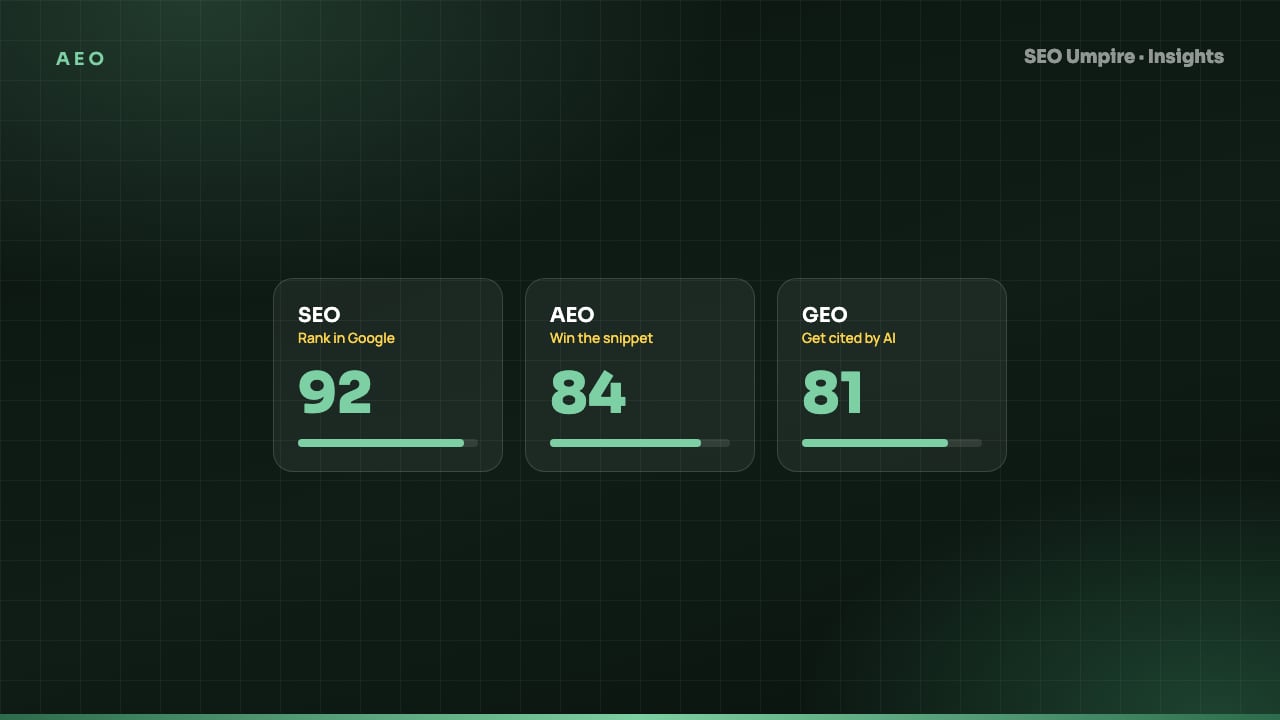
SEO vs AEO vs GEO: Differences, Overlap and Which to Use
SEO ranks pages in results, AEO wins the extracted answer box, GEO earns citations inside AI answers. Compare goals, tactics and metrics side by side.
 AEO
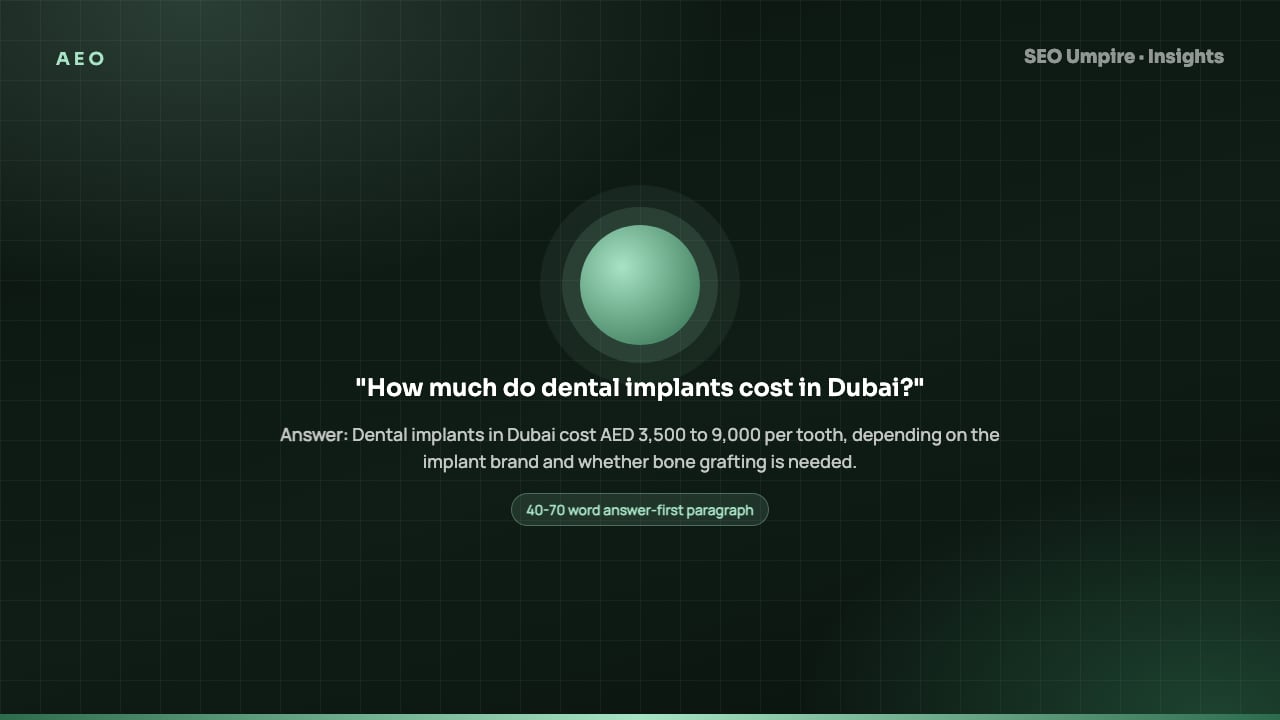
Answer Engine Optimization (AEO): The Complete Guide
Answer engine optimization (AEO) structures content so featured snippets, voice assistants and AI engines quote it directly. The 8-step method and metrics.
 SEO Basics
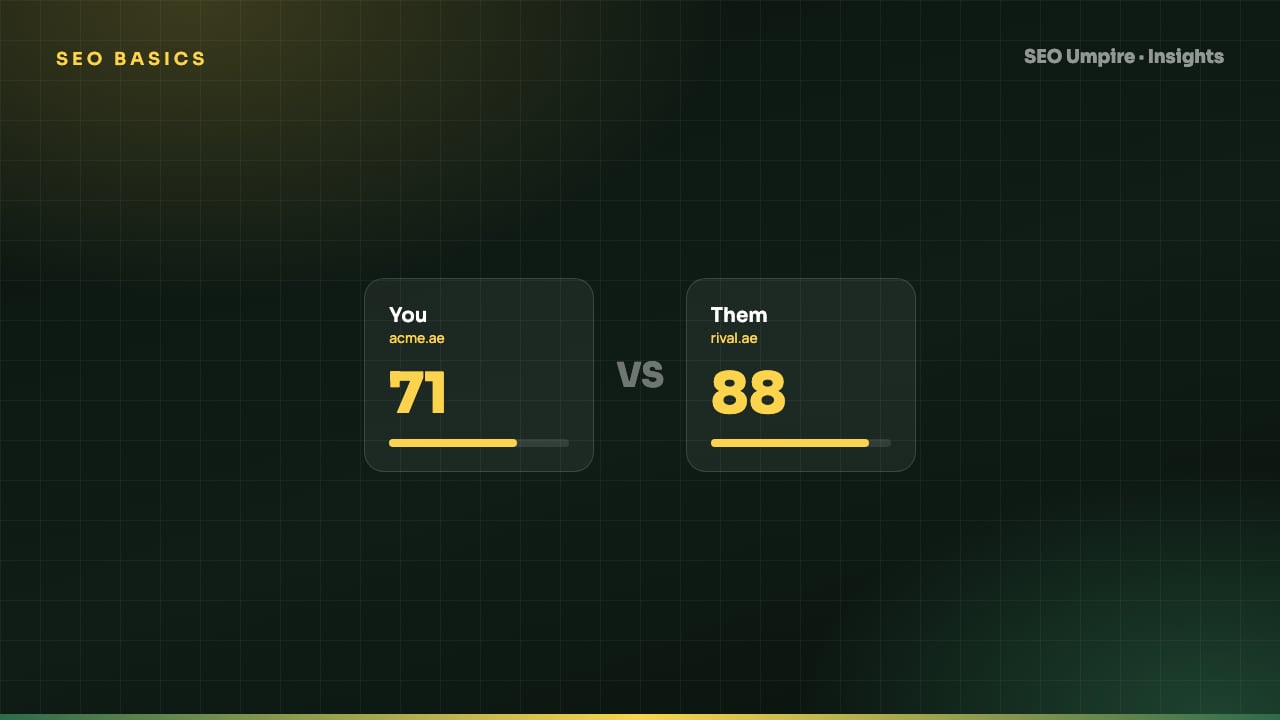
Competitor SEO Analysis: A 7-Step Process to Find Keyword Gaps
Competitor SEO analysis in 7 steps: find your real search competitors, run a keyword gap analysis, compare content, technical health, links and AI citations.
One short email a week: what changed in Google and AI answers, and the fixes that matter. No spam, unsubscribe any time.