

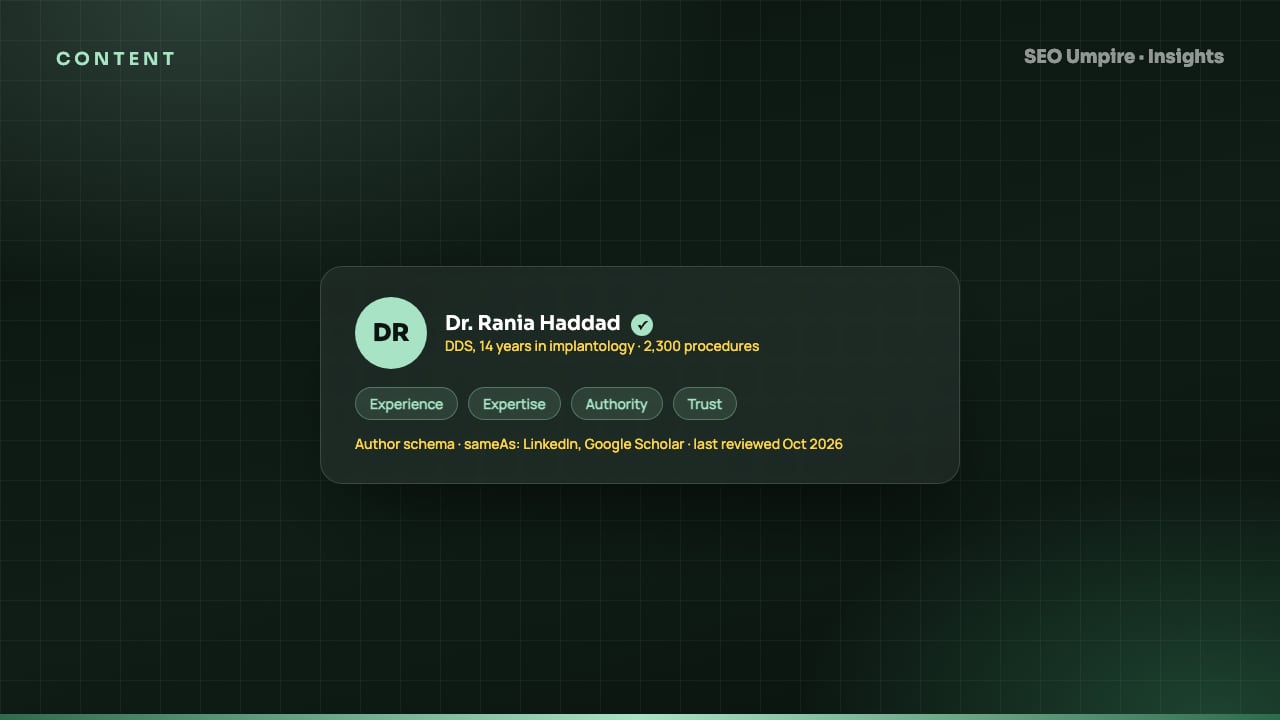
E-E-A-T SEO Guide: How to Show Experience, Expertise and Trust
E-E-A-T SEO explained: what Experience, Expertise, Authoritativeness and Trust mean, why E-E-A-T is not a ranking factor, and 14 on-page signals that show it.
E-E-A-T stands for Experience, Expertise, Authoritativeness and Trustworthiness. It is the framework in Google's Search Quality Rater Guidelines that human raters use to judge whether a page and its creator deserve to be trusted, and Google's ranking systems are built to reward content with those qualities. E-E-A-T is not a single ranking factor or score, but demonstrating it on the page, on author profiles and across the site is one of the most reliable ways to rank for competitive and sensitive queries, and to be chosen as a cited source by AI answer engines.
This guide explains what each letter means in practice, which pages need it most, and 14 concrete signals you can add this week.
What is E-E-A-T and where does it come from?
Google publishes Search Quality Rater Guidelines, a document used by thousands of human raters who evaluate search results. Their ratings do not change rankings directly; they are used to measure whether algorithm changes improve results. E-A-T (Expertise, Authoritativeness, Trustworthiness) appeared in those guidelines in 2014. In December 2022 Google added a second E for Experience and made Trust the center of the model.
The four parts:
- Experience: the creator has first-hand involvement with the topic. A review by someone who used the product. A travel guide by someone who went. A tutorial by someone who did the thing.
- Expertise: the creator has the knowledge or skill. Formal credentials for medical or legal topics; demonstrated skill for hobbies and trades.
- Authoritativeness: the creator or site is a recognized go-to source, shown by what others say and link.
- Trustworthiness: the page is accurate, honest, safe and transparent. Google calls this the most important member of the family; a page that is not trustworthy fails regardless of the other three.
Is E-E-A-T a ranking factor?
No, not directly, and this distinction matters for how you work. There is no E-E-A-T meter. Google's systems look for signals that correlate with what raters would judge as high E-E-A-T: links and mentions from authoritative sites, consistent author entities, accurate information that agrees with consensus on factual matters, site reputation, and user satisfaction. Your job is to make those signals real and visible, not to game a metric.
Which pages need E-E-A-T most?
Google applies the highest bar to Your Money or Your Life (YMYL) topics: health, medicine, finance, law, safety, news and civic information, and major purchases. On YMYL topics, formal expertise and verifiable trust signals are close to mandatory. On everyday topics (recipes, hobbies, product reviews), experience often matters more than credentials.
| Topic type | Which E matters most | Minimum signals |
|---|---|---|
| Medical, legal, financial | Expertise and Trust | Credentialed author or reviewer, citations to primary sources, dated review, disclaimer, clear ownership |
| Product reviews | Experience | Original photos, test data, pros and cons, how it was tested, affiliate disclosure |
| How-to and tutorials | Experience and Expertise | Author has done it, screenshots, step results, failure cases |
| Local services | Trust and Authority | Real business details, reviews, licenses, staff pages |
| News and current events | Trust and Authority | Bylines, corrections policy, sourcing, publication standards |
| Entertainment, hobbies | Experience | Clearly personal, first-hand perspective |
14 signals that demonstrate E-E-A-T
On every article
- A named author with a bio stating relevant qualifications or experience, linked to an author page.
- A reviewer line for YMYL content ("Medically reviewed by Dr. ..., last reviewed on ..."), with the reviewer's own page.
- Published and updated dates that are honest. Fake "updated today" dates destroy trust when raters check.
- First-hand evidence: original photos, screenshots, measurements, test results, quotes from people you interviewed.
- Citations to primary sources with outbound links: studies, official documentation, regulators, manufacturer specs.
- Specific, falsifiable statements instead of hedged generalities. "We measured 1.8 s LCP on a $5 shared host" beats "speed is important".
- Honest limitations: what you did not test, where the advice does not apply, when to consult a professional.
On author pages
- Full bio, photo, role, credentials, and years of experience, with links to the author's profiles elsewhere (LinkedIn, professional registry, publications).
- Person schema linking the author entity to those profiles via
sameAs. - A list of the author's articles on the site, so the entity has a consistent body of work.
Across the site
- About page with who runs the site, why, the company's legal name and location, and editorial standards.
- Contact page with a real address, phone or email, and response expectations.
- Policy pages: privacy, editorial or review methodology, corrections, affiliate disclosures.
- Technical trust: HTTPS, no deceptive ads or interstitials, no broken pages, fast and stable layouts. A site that fails the basics in the technical SEO checklist reads as careless to raters and users alike.
How to improve E-E-A-T in 30 days: a step-by-step plan
- Week 1: Audit. Crawl the site with the SEO Umpire site audit and list every article without an author, every author without a bio, and every YMYL page without a reviewer or sources. Check About, Contact and policy pages exist and are linked from the footer.
- Week 2: Fix authorship. Create author pages with bios, photos and Person schema. Assign real authors to orphaned articles or mark them as staff with an editorial team page.
- Week 3: Add evidence to your top 20 pages. For each, add one original piece of first-hand evidence, cite two primary sources, and add an honest limitations paragraph. Use the AI schema generator to add Article schema with
authorandreviewedBy. - Week 4: Build external authority. Pitch one expert quote to a trade publication, update professional directory profiles, and ask partners or clients for a mention. Track the target pages in the rank tracker to measure the effect over the next quarter.
E-E-A-T and AI content
Content drafted with AI has no experience of its own. That is why it so often reads as generic. The fix is not to avoid AI but to inject experience: your data, your tests, your photos, your expert's edits. Read does AI content rank for the production workflow that keeps E-E-A-T intact.
Why E-E-A-T matters for answer engines too
ChatGPT, Perplexity and Google AI Overviews choose sources to cite, and they prefer sources that are clearly attributed, specific and consistent with other trusted sources. A page with a credentialed author, primary citations and precise statements is exactly what a generative engine can quote with confidence. The signals in this guide are the same ones covered in how to get cited by ChatGPT, Perplexity and AI Overviews, so the work is not duplicated.
Common E-E-A-T mistakes
- Generic "Admin" or company-name authors on expert content
- Author bios invented to look credentialed (raters and competitors check)
- Medical or financial advice with no reviewer and no sources
- Review sites with no evidence the product was ever used
- Hidden ownership: no address, no company name, no people
- Aggressive ads or affiliate links that outnumber the content
- Copying consensus facts wrong, which contradicts every trusted source
Run the free SEO checker on your most important YMYL page; the structure and schema findings are the quick fixes, and the author, source and policy gaps are the ones that move trust.
Frequently asked questions
Is E-E-A-T a Google ranking factor?
Not directly. E-E-A-T comes from the Search Quality Rater Guidelines, which human raters use to evaluate results. Google's ranking systems use many signals designed to identify content with the qualities E-E-A-T describes, so demonstrating it matters even though there is no single E-E-A-T score.
What does the extra E in E-E-A-T stand for?
Experience. Google added it in December 2022 to recognize content created by someone with first-hand, lived experience of the topic, such as actually using a product, visiting a place or going through a process.
What are YMYL topics?
Your Money or Your Life topics are those that could affect a person's health, finances, safety or well-being, such as medical, legal, financial and news content. Google holds YMYL pages to a much higher E-E-A-T standard.
How do I show E-E-A-T on a small site?
Put a real author with a relevant bio on every article, include first-hand evidence such as photos and test results, cite sources, add an About page with company details, a contact page, and privacy and editorial policies, and keep the site on HTTPS with no misleading ads.
Free audit, 32 checks, prioritized fixes and a PDF report in about 15 seconds. No signup.
Keep reading
 Content
Google Trends for SEO: 9 Ways to Use It for Keywords and Content
How to use Google Trends for SEO: read the 0 to 100 index, compare keyword variants, plan seasonal content, find rising queries and check demand by country.
 Content
Does AI Content Rank on Google? What Actually Works in 2026
Does AI content rank? Yes when it is accurate, original and reviewed; no when it is mass-produced filler. What Google's policy says and a workflow that ranks.
 Content
Keyword Research by Country: How to Target Each Market
Keyword research by country pulls volume, difficulty and SERP data per Google country database, then adapts for local language, spelling and intent. The method.
One short email a week: what changed in Google and AI answers, and the fixes that matter. No spam, unsubscribe any time.