

Meta Description Best Practices: Length, Formula, Examples
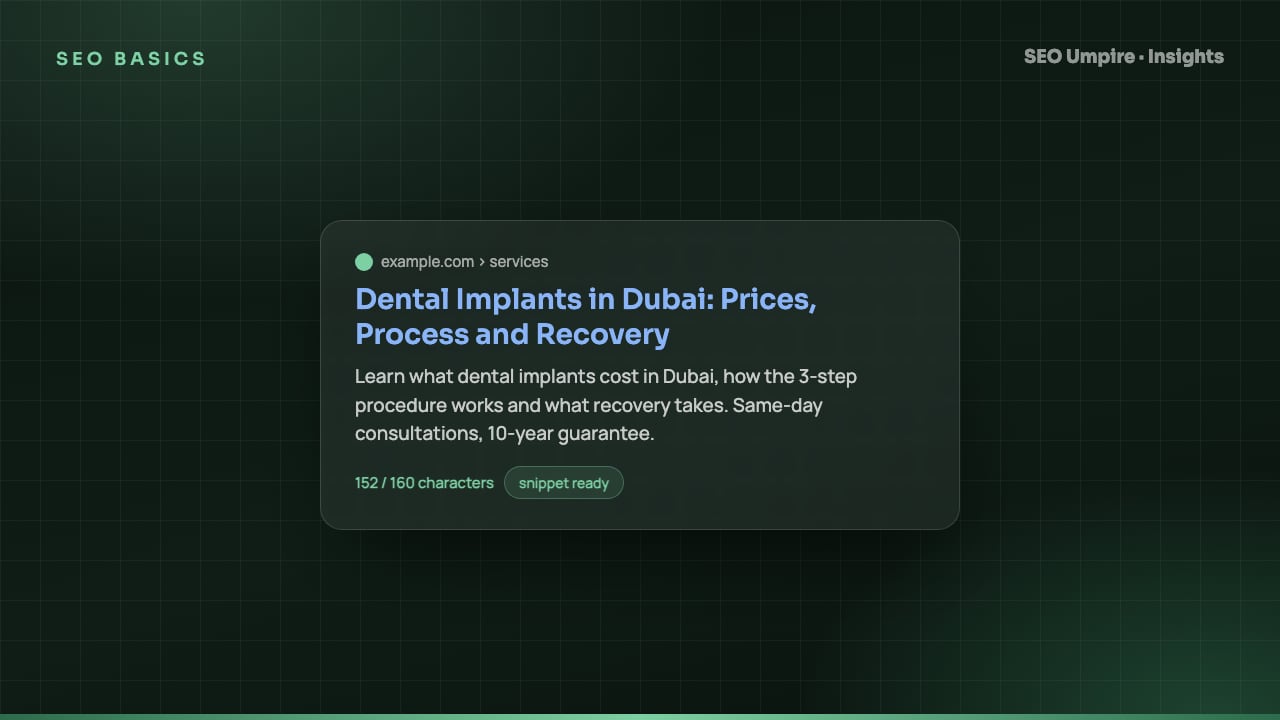
Meta description best practices: write 140 to 160 characters that answer the query first, include the keyword and give a reason to click. Formula and examples.
Meta description best practice is to write 140 to 160 characters that answer the searcher's query in the first sentence, include the primary keyword naturally, and give one concrete reason to click. Google displays roughly 155 to 160 characters on desktop before cutting with an ellipsis, and mobile often shows fewer, so the important words belong in the first 120. Meta descriptions are not a ranking factor, but they drive click-through rate, and Google will replace a weak one with text from the page.
This guide covers the length limits, how Google rewrites descriptions, a formula with examples by page type, and how to fix descriptions across a whole site.
What is a meta description?
A meta description is an HTML element in the page <head> that summarizes the page for search engines and social networks:
<meta name="description" content="Meta description best practices: write 140 to 160 characters that answer the query first, include the keyword and a reason to click. Formula and examples.">
Search engines may show it as the gray text beneath the title in results. It does not appear on the page itself. Social networks fall back to it when og:description is absent.
How long should a meta description be?
Google truncates descriptions by pixel width, around 920 pixels on desktop, which corresponds to roughly 155 to 160 characters of normal text. Mobile shows a variable amount, frequently 120 characters or fewer, depending on device and whether a date or rich result occupies space.
| Surface | Approximate visible length |
|---|---|
| Google desktop | 155 to 160 characters (about 920 px) |
| Google mobile | 100 to 130 characters, variable |
| Bing desktop | Around 160 characters |
| Social share fallback | 150 to 200 characters, platform-dependent |
The practical target is 140 to 160 characters, with the answer and keyword inside the first 120. Shorter than 100 wastes the space; longer than 165 is truncated and reads as if it was never finished. A free SEO checker reports the length and pixel width for any URL.
Do meta descriptions affect rankings?
Google has said the meta description is not used in ranking. Its effect is indirect and still significant:
- Click-through rate. The description is the only copy you control under the title. A specific, matching description earns clicks from the same position.
- Rewrites. When Google judges a description unhelpful for a query, it substitutes a snippet from the page. A good description reduces rewrites and keeps your message intact.
- Bolded query terms. Google bolds words in the description that match the query, which draws the eye. Including the keyword naturally earns that emphasis.
Because the description is read together with the title, write them as a pair. The title tag length guide covers the title half.
Why does Google rewrite meta descriptions?
Google replaces descriptions frequently, often more than half the time for long-tail queries. The common triggers:
- The description does not address the specific query (a generic description on a page that ranks for many queries)
- It is duplicated across pages
- It is stuffed with keywords or reads like a list
- It is empty, so there is nothing to show
- A passage in the page body answers the query more directly
You cannot stop rewrites entirely, and for long-tail queries a page-text snippet may serve the user better. What you can do is make the first paragraph of the page an answer-first statement, so that if Google does pull from the page it pulls something good. This is the same principle that answer engine optimization relies on.
How to write a meta description: the formula
Direct answer or value statement (with the keyword) + one specific proof or detail + implicit or explicit next step
Writing rules:
- Lead with the answer. If the query is "how long should a meta description be", the first words should say 140 to 160 characters.
- Use the keyword once, naturally. It will be bolded. Twice looks stuffed.
- Be specific. Numbers, names, outcomes: "7 steps", "free", "under 60 seconds", "with examples". Vague adjectives ("comprehensive", "ultimate") earn nothing.
- Match intent. Informational pages promise an explanation; commercial pages state price, range or guarantee; transactional pages state availability and the action.
- Write in active voice, present tense. "Learn how", "Compare", "Check" work. "This page will discuss" wastes 22 characters.
- Make every description unique. Templated descriptions must insert page-specific variables.
- Stay between 140 and 160 characters. Count, or let a tool count.
- Avoid double quotes in the content attribute (they break the HTML) and avoid long dashes, which render inconsistently.
Meta description examples by page type
| Page type | Example (length) |
|---|---|
| Guide | Meta description best practices: write 140 to 160 characters that answer the query first, include the keyword and a reason to click. Formula and examples. (155) |
| Tool page | Check any URL's SEO in under 60 seconds. Free SEO checker tests indexing, Core Web Vitals, titles, meta tags, links and schema, then lists fixes by priority. (157) |
| Product | Rank tracker with daily positions by keyword, country and device, SERP feature tracking and shareable reports. Plans from the free tier. Start in 2 minutes. (156) |
| Comparison | SEO ranks pages, AEO wins the answer box, GEO earns AI citations. Compare goals, tactics and metrics side by side and learn how one page can do all three. (154) |
| Local service | Plumber in Austin with same-day service, upfront pricing and a 12-month guarantee on repairs. Licensed and insured. Call or book online in 60 seconds. (150) |
| Category | Browse 42 WordPress SEO plugins compared on features, speed impact, schema support and price. Updated monthly with hands-on test notes. (139) |
Each one answers the implied question first, includes one or two concrete details and leaves an obvious reason to click. The AI meta tool drafts descriptions in this pattern from the page content and flags any outside the length band.
How to fix meta descriptions across a whole site
- Crawl and export. Run a site audit and export URL, description, length, and whether the page is indexable.
- Filter the failures. Missing descriptions, duplicates, under 100 or over 165 characters, and descriptions identical to the title.
- Prioritize by traffic. Sort by clicks or impressions from Search Console. The top 50 pages get hand-written descriptions this week; the rest get a template.
- Build templates per content type. Products:
{name}: {key spec}, {price}. {shipping or guarantee}. {brand}.Articles:{answer sentence}. {what the reader gets}.Make sure the variables produce unique output. - Write the top pages by hand using the formula and the query data from Search Console. Address the actual queries the page ranks for.
- Deploy, recrawl, verify. Confirm no description exceeds 160 characters and none is duplicated.
- Measure click-through rate per page in Search Console over the next four to six weeks, comparing the same position range before and after. Descriptions change CTR, not position, so compare at constant rank.
WordPress sites can do steps 1 to 6 inside the SEO Umpire plugin, where the Umpire Agent fills blanks and duplicates with drafts for approval. Review titles, headings and descriptions in the same pass.
Common meta description mistakes
- Leaving the field blank and letting the CMS output nothing
- The same description on every page or every product in a category
- Describing the company instead of the page ("We are a leading provider of...")
- Keyword lists separated by commas
- Writing 300 characters and hoping the right half shows
- Promising something the page does not deliver, which raises bounce rate and, over time, hurts the page
- Forgetting that
og:descriptionis separate and can be written for sharing rather than search
Frequently asked questions
How long should a meta description be?
Between 140 and 160 characters. Google truncates at roughly 920 pixels on desktop, which is about 155 to 160 characters, and mobile often shows less. Put the important words in the first 120 characters.
Do meta descriptions affect SEO rankings?
Not directly; Google has said they are not a ranking factor. They affect click-through rate, and a page that earns more clicks for its position tends to gain traffic even at the same rank.
Why does Google ignore my meta description?
Google replaces descriptions it judges a poor match for the query, usually with a passage from the page. It happens more with vague, duplicated or keyword-stuffed descriptions and for long-tail queries the description does not address.
Should every page have a unique meta description?
Yes, for every indexable page you want clicks from. For large catalogs, use a template that inserts the product name, key spec and price so each one is distinct, and hand-write the top traffic pages.
Free audit, 32 checks, prioritized fixes and a PDF report in about 15 seconds. No signup.
Keep reading
 SEO Basics
Competitor SEO Analysis: A 7-Step Process to Find Keyword Gaps
Competitor SEO analysis in 7 steps: find your real search competitors, run a keyword gap analysis, compare content, technical health, links and AI citations.
 SEO Basics
How Long Does SEO Take? Realistic Timelines by Site Type
How long does SEO take? Usually 3 to 6 months for measurable gains and 6 to 12 for competitive keywords. Timelines by site type and tactic, month by month.
 SEO Basics
Local SEO Guide: How to Rank in the Map Pack and Local Results
Local SEO explained: how Google ranks the map pack on relevance, distance and prominence, with steps for Business Profile, reviews, citations and schema.
One short email a week: what changed in Google and AI answers, and the fixes that matter. No spam, unsubscribe any time.